
Steam Community Market vs Third-Party Marketplaces: Where Should You Actually Sell?
 CornieEditor & Lead ReviewerAugust 4, 2026 7 min read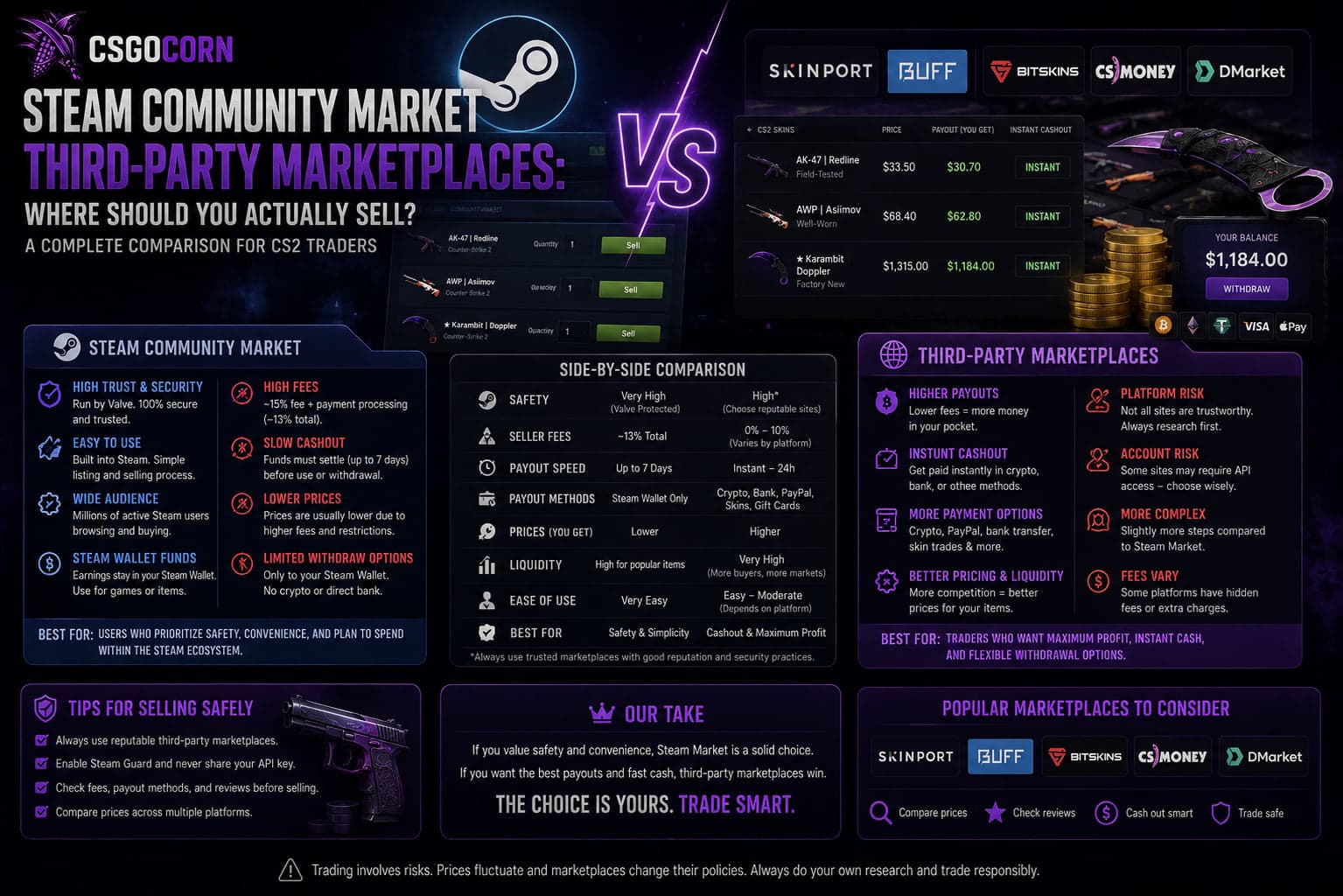
There are two fundamentally different ways to sell a CS2 skin, and choosing between them is not a matter of which is better. It is a matter of what you want at the end: Steam credit, or money in a bank account.
That single distinction decides most of the answer. Everything else — fees, speed, liquidity, risk — is detail layered on top of it. This guide works through the detail honestly, including the parts that make third-party selling less attractive than the marketing suggests.
The one difference that matters most
The Steam Community Market is a closed loop. You sell a skin, the balance lands in your Steam Wallet, and that balance can only ever be spent on Steam. There is no withdrawal button. There never has been.
Third-party marketplaces exist because of that constraint. They let you convert skins into money you can actually withdraw — crypto, bank transfer, e-wallet, gift cards. That capability is the entire value proposition, and it is also the reason they carry risks Steam does not.
So before comparing anything else: if you are selling in order to buy a different skin or a game, Steam is almost certainly the right venue. If you are selling to get paid, it cannot help you at all.
Fees: the number and the real number
Steam takes a cut of every market sale. The listed price and the amount you receive are meaningfully different, and the calculator on the listing page shows you both — read it before you set a price rather than after.
Third-party venues charge in more varied ways, and the headline rate is rarely the whole story:
- Commission on sale — the advertised percentage.
- Withdrawal fees — often separate, and often where the margin actually is.
- Payment processor spread — the exchange rate applied when converting, which can quietly cost more than the commission.
- Minimum withdrawal thresholds — money that exists in your account but cannot leave it yet.
The only figure worth comparing is the amount that arrives in your account. We record that number rather than the advertised rate when we test a venue, and the process is written up on our methodology page.
Liquidity: how fast does it actually sell?
Steam has by far the deepest pool of buyers for common items. A mid-tier skin listed slightly under the lowest existing price generally sells within minutes. Nothing else in the ecosystem matches that for everyday items.
The picture flips for expensive and unusual items. Steam caps how much a single item can sell for, which puts high-tier knives and rare patterns out of its reach entirely. It also does not display float values or pattern indexes in listings, so the attributes that make a rare item valuable are invisible to buyers. A 0.0002 Factory New sits next to a 0.06 at the same price, and there is no mechanism for the seller to be paid for the difference.
That is why the serious end of the market lives on third-party CS2 marketplaces: they show float, pattern and sticker detail, and they have no ceiling on item value.
Speed: instant cashout versus listing and waiting
Third-party venues split into two models, and they suit different needs.
Instant sell
The site buys your skin immediately at a price it sets. You get paid quickly and you accept a discount against market value in exchange. This is the right choice when speed is the priority — see our list of instant cashout sites for the venues we have tested.
Peer-to-peer listing
You list at your own price and wait for a buyer. You keep more of the value, but the item may sit for days, and you carry the price risk while it does.
The gap between those two outcomes is real money. Deciding which matters more before you start saves a lot of second-guessing.
Risk: the part that deserves the most attention
Steam's risk profile is simple. Valve holds the items, the transaction is atomic, and you are not trusting a third party with anything. The main hazard is your own account security.
Third-party marketplaces ask you to trust an operator. Sometimes that trust is entirely well placed and sometimes it is not, and the difference is not visible from the homepage. What to check:
- Operating history. A site that has paid out reliably for years has demonstrated something a new one simply cannot yet.
- Withdrawal reports from real users. Not the testimonials on the site — independent reports of money actually arriving.
- Clear terms on holds and limits. Vague or shifting withdrawal rules are the most common way a payout stalls.
- Support that responds before you need it. Test this while nothing is wrong.
Phishing sites imitating well-known marketplaces are a persistent problem, so check the domain character by character before signing in. Our guide on spotting skin scams goes through the specific patterns.
Trade holds apply everywhere
No venue can bypass a Steam trade hold. If your item is on a seven-day timer, it is illiquid regardless of where you intend to sell it. Any service claiming otherwise is misrepresenting what it does. Our trade hold guide covers the current rules.
Payout methods and what each one costs
On a third-party venue, the withdrawal method you pick can matter as much as the commission rate. The common options behave differently:
- Crypto. Usually the fastest and often the cheapest, but you absorb network fees and exchange-rate movement, and a mistyped address is unrecoverable.
- Bank transfer. Predictable and traceable, slower to arrive, and frequently subject to a minimum withdrawal that can strand small balances.
- E-wallets. A middle ground on speed, with their own fee layer on top of the site's.
- Gift cards. Sometimes offered at a favourable rate precisely because they are not really cash — worth taking only if you would have bought the thing anyway.
Before your first withdrawal, find the minimum threshold and the fee schedule. Discovering that your balance is below the minimum after you have already sold is a common and entirely avoidable annoyance.
Buying, not just selling
Most comparisons only consider the sell side, but the venues differ just as much when you are buying.
On Steam you pay in Wallet funds, which is convenient if you already have a balance from previous sales — and that balance had nowhere else to go anyway. What you cannot do is see the float or pattern of what you are buying, so Steam is a poor place to shop for anything where those attributes matter.
On third-party marketplaces you pay with real money and you can see exactly what you are getting: float, pattern seed, stickers, inspect link. For a specific item with specific attributes, that visibility is the entire reason to shop there. The trade-off is that you are funding an account on a platform you need to trust, rather than spending credit already sitting in Steam.
A pattern that works well for a lot of traders: sell common items on Steam and spend that credit on Steam, while handling anything attribute-sensitive — in either direction — on a marketplace where the attributes are visible.
A decision framework
- Want Steam credit, common item, want it gone today? Steam Community Market.
- Want real money, need it fast, willing to take a discount? An instant cashout site.
- Want real money, item is valuable or has notable float or pattern? A peer-to-peer marketplace where those attributes are visible.
- Item is above Steam's price ceiling? Third-party is the only option.
Frequently Asked Questions
Can I withdraw money from the Steam Community Market?
No. Steam Wallet funds can only be spent on Steam. Converting skins into withdrawable money requires a third-party marketplace.
Are third-party CS2 marketplaces safe?
The established ones with long payout histories generally are, but the category as a whole varies enormously. Judge each site on its operating history, withdrawal reliability and how clearly it states its terms — and never sign in through a link you did not type yourself.
Which is cheaper, Steam or third-party?
It depends entirely on the item and the payout method. Compare the amount that actually reaches you, not the advertised commission rate.
Why can't I sell my expensive knife on Steam?
Steam caps the maximum price of a single market listing. Items worth more than that ceiling cannot be sold there at their real value.
Does float matter more on third-party sites?
Yes, because they display it. Steam listings do not show float, so a low-float item earns no premium there.
The short version
Steam for convenience, liquidity on common items, and safety — as long as Steam credit is what you want. Third-party for real money, for valuable items, and for anything where float or pattern is part of the price. Compare what lands in your account, and treat operator trust as the main variable.
Ready to pick one? We tested and ranked the CS2 gambling sites — deposits, payouts, bonus terms and all.
See the tested CS2 gambling sitesRelated posts
How to Read the CS2 Skin Market: Price History, Volume and Timing
Most people check one price and call it research. This guide covers what a price chart actually tells you, why trade volume matters more than the headline number, the events that move the market, and how to avoid the mistakes that cost traders money.
CS2How to Spot a CS2 Skin Scam: Red Flags Every Trader Should Know
Skin scams work because they exploit urgency and trust, not technical weaknesses. This guide breaks down the API key hijack, the fake middleman, the impersonated marketplace and the quick-swap, plus the habits that make you a hard target.
CS2CS2 Skin Patterns Beyond Blue Gem: Fade, Doppler, Marble Fade and Case Hardened
Pattern index is the hidden number that turns an ordinary skin into a four-figure one. This guide explains how pattern seeds work, what makes a high Fade percentage, how Doppler phases are priced, and which patterns are worth hunting.