
How to Spot a CS2 Skin Scam: Red Flags Every Trader Should Know
 CornieEditor & Lead ReviewerAugust 4, 2026 7 min read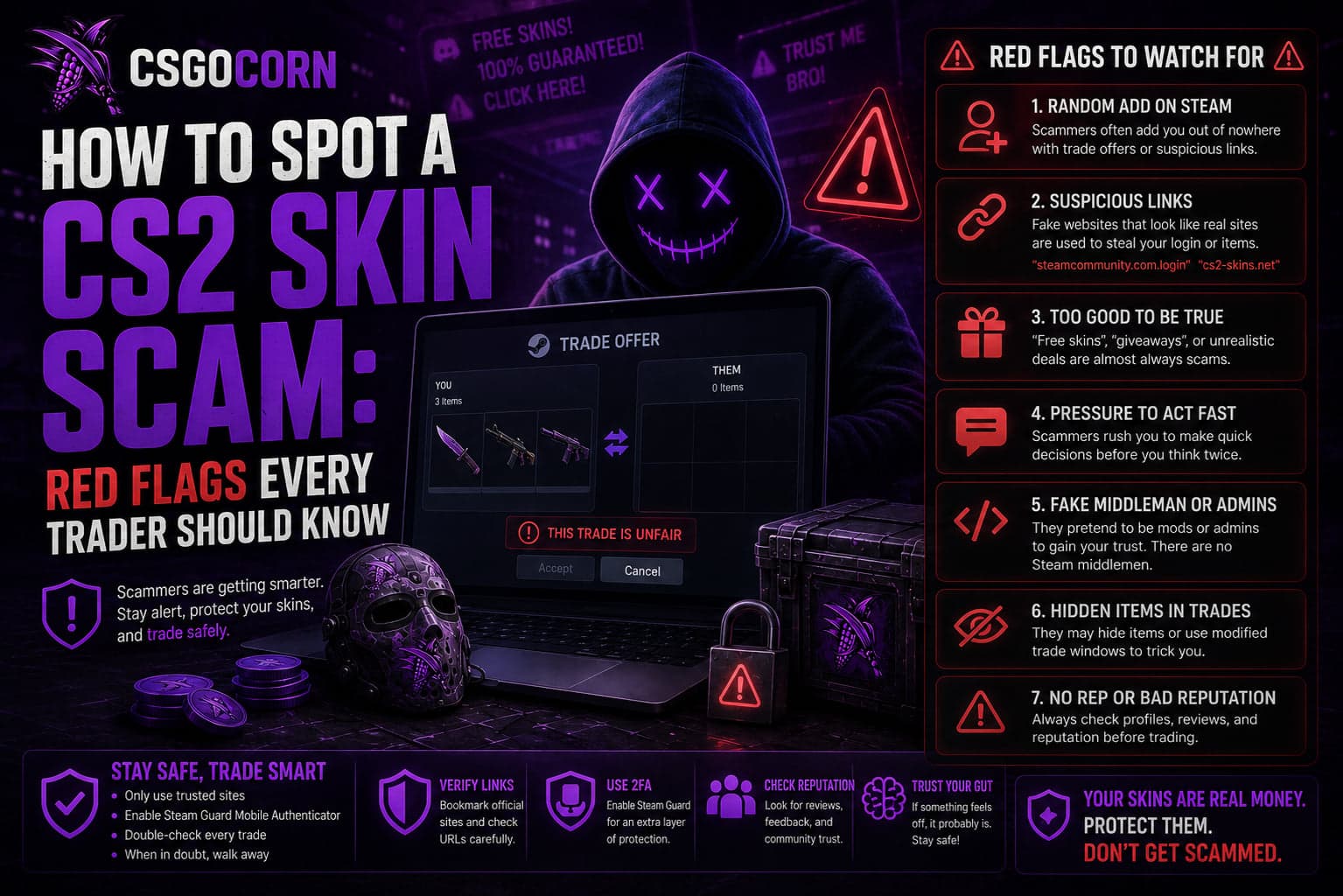
Almost every skin scam that succeeds does so for the same reason: the victim was rushed. Not outsmarted, not hacked in any technical sense — rushed into acting before checking something they would normally check.
That is good news, because it means the defence is mostly procedural. This guide covers the scams that still work, the exact signals that give them away, and the small number of habits that make you an inconvenient target.
The API key hijack
This is the most damaging one and the least understood. The attacker gets you to sign in to a page that looks like a Steam login. Rather than simply stealing the password, they register an API key on your account. That key lets them see your trades and cancel them in real time.
What you experience: you send a trade to a friend, confirm it on your phone, and the items go to a stranger. From your side everything looked normal, because the original offer was cancelled and replaced with an identical-looking one to the attacker's account in the moment between your confirming and the trade completing.
How to defend against it
- Never sign in to Steam through a link someone sent you. Type the address yourself, every time.
- Check your registered API keys in your Steam account settings and revoke anything you did not create.
- Read the trade confirmation on your phone properly — the recipient name is right there.
- If items ever vanish unexpectedly, change your password and revoke API keys immediately, in that order.
The fake middleman
In a three-way trade, someone offers to hold both sides' items to guarantee fairness. They present themselves as a known community figure or an admin of a trading group, often with a profile carefully built to look established.
The items go in and nothing comes out.
The rule here is absolute and worth stating plainly: there is no such thing as a trusted individual middleman. Not a friend of a friend, not someone with a lot of comments, not someone whose profile says "verified". If a trade genuinely needs an escrow, use a marketplace that provides one as a platform function.
The impersonated marketplace
Phishing domains imitating well-known trading sites are relentless. The page is often a pixel-perfect copy; the only difference is the address bar — a swapped letter, an extra hyphen, a different top-level domain, a lookalike character.
- Type the domain manually or use your own bookmark. Never a link from chat, a comment, or an ad.
- Read the domain character by character before entering anything.
- Be sceptical of search ads for trading sites; the top result is not necessarily the real one.
- Use a password manager — it will refuse to autofill on a domain that does not match, which is a genuinely useful alarm.
Every site in our reviews section lists its official domain, which gives you a reference point you did not get from a stranger.
The quick-swap
You agree a trade for a specific item. In the trade window, the scammer swaps it for a visually similar one — a different wear tier, a StatTrak swapped for a plain version, a similar-looking skin from another collection — and pressures you to accept before you look closely.
The defence is one sentence: read every line of the trade window before confirming, and treat any pressure to hurry as the signal it is. Nobody with a legitimate trade minds you taking thirty seconds.
The "your account is banned" panic
A message claims your account has been reported and will be banned unless you verify with a Steam employee, who then asks you to trade your items away for "safekeeping" or confirm a login.
Valve does not contact players this way. Valve employees do not message you on Steam, Discord or anywhere else about bans. The entire scam depends on panic overriding that knowledge.
The fake payment
Selling for real money outside a marketplace, you receive a screenshot of a transfer or a payment that arrives and is later reversed. Reversible payment methods are the whole mechanism — the buyer gets the skin, then claws the money back.
If you are selling for cash, sell through a cashout site or a marketplace that handles payment. Person-to-person cash deals with strangers put all the risk on you and none on them.
Discord and community scams
A growing share of skin scams no longer start on Steam at all. They start in a trading Discord, a comment on a profile, or a reply to a post about selling.
- The impersonated staff member. A profile copies the username and avatar of a server admin, then messages you privately about a "verification". Real admins do not need you to trade anything to prove anything.
- The fake bot invite. A link claims to add a trading bot to a server and instead requests account permissions. Read what any authorisation screen is actually asking for.
- The vouch farm. A server full of glowing testimonials, most posted by accounts created the same week. Volume of praise is not evidence; age and independence of the sources is.
- The friend whose account was taken. A message from someone you know, asking for a favour involving items. If the request is unusual, verify through a channel that is not the compromised one.
The common thread is that all of these move you off a platform with protections onto one without any. Every step away from a marketplace's escrow is a step you are taking on trust alone.
Trade-locked item scams
Because held items cannot move, some scams are built entirely around the wait. The pitch is that you pay now and receive the item when it unlocks in a few days. There is no mechanism forcing the other side to follow through, and a week is plenty of time for an account to go quiet.
If you genuinely want to buy a locked item, do it through a marketplace that holds the funds until delivery completes. Paying a stranger for a future delivery is not a trade; it is a loan with no borrower.
Habits that make you hard to target
- Steam Mobile Authenticator enabled, and actually read the confirmations rather than tapping through them.
- Bookmarks, not links. For every trading site you use.
- Periodic API key audit. Takes a minute, catches the worst attack.
- A personal rule about urgency. Any deal that must happen right now is a deal you can decline.
- Separation. Do not reuse your Steam password anywhere else.
If it has already happened
- Change your Steam password immediately, then revoke every API key.
- Deauthorise other devices from Steam settings.
- Run a malware scan — some of these start with a compromised machine rather than a phishing page.
- Report the profile to Steam Support. Recovery is not guaranteed, but reports do contribute to bans.
- Warn the community you were operating in. It is the fastest way to stop the same profile working the next person.
Frequently Asked Questions
Can Steam recover scammed skins?
Sometimes, in cases involving a compromised account, but there is no guarantee and it depends on the circumstances. Prevention is far more reliable than recovery.
What is an API key scam?
An attacker registers a Steam API key on your account after a phishing login, then uses it to cancel your outgoing trades and substitute their own. Your items appear to go to the intended recipient but do not.
Are middleman services ever safe?
A marketplace acting as escrow at platform level is a legitimate mechanism. An individual person offering to hold items is not, regardless of their reputation.
How do I check my Steam API keys?
Through your Steam account's developer API key page. Revoke anything you did not personally create.
Is it safe to use third-party skin sites at all?
Established ones with long payout histories are widely used without issue. The risk is concentrated in new or unknown operators and in phishing clones of real sites — which is why typing the domain yourself matters so much.
The short version
Every one of these attacks needs you to move fast and skip a check. Type your own URLs, read your trade confirmations, audit your API keys, and treat urgency as a red flag rather than a reason. That covers the overwhelming majority of it.
Ready to pick one? We tested and ranked the CS2 gambling sites — deposits, payouts, bonus terms and all.
See the tested CS2 gambling sitesRelated posts
How to Read the CS2 Skin Market: Price History, Volume and Timing
Most people check one price and call it research. This guide covers what a price chart actually tells you, why trade volume matters more than the headline number, the events that move the market, and how to avoid the mistakes that cost traders money.
CS2CS2 Skin Patterns Beyond Blue Gem: Fade, Doppler, Marble Fade and Case Hardened
Pattern index is the hidden number that turns an ordinary skin into a four-figure one. This guide explains how pattern seeds work, what makes a high Fade percentage, how Doppler phases are priced, and which patterns are worth hunting.
CS2CS2 Gloves Explained: Every Glove Type, Which Cases Drop Them, and What Drives the Price
Gloves share the same 0.26% gold tier as knives but behave very differently on the market. This guide covers every glove type in CS2, which cases actually contain them, why wear matters more on gloves than on any weapon, and how to buy without overpaying.