
CS2 Skin Patterns Beyond Blue Gem: Fade, Doppler, Marble Fade and Case Hardened
 CornieEditor & Lead ReviewerAugust 4, 2026 6 min read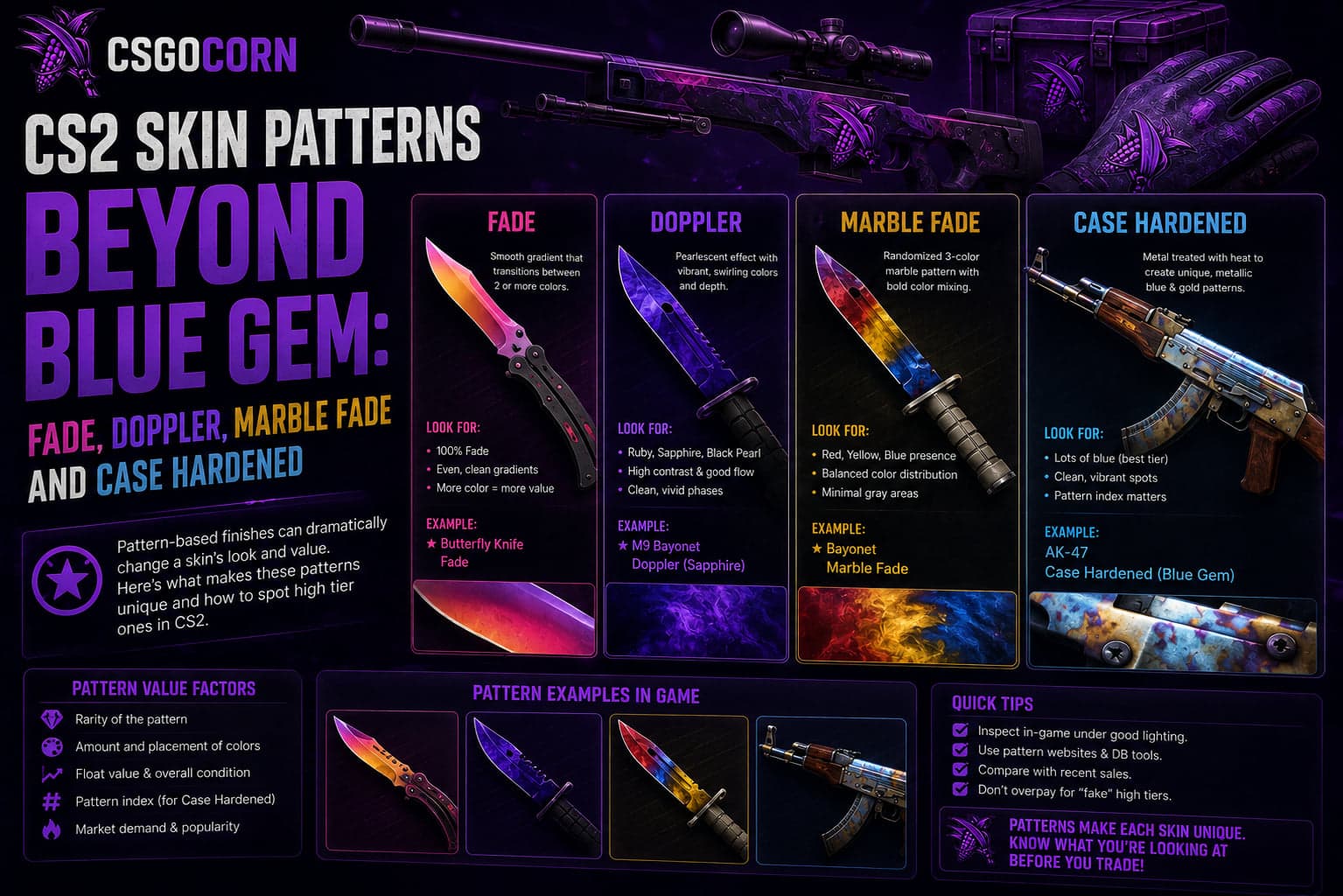
Two skins can share a name, a wear tier and a float value and still be worth wildly different amounts. The reason is the pattern index — a second hidden number, assigned at creation, that decides how the artwork is positioned on the weapon.
Case Hardened blue gems are the famous example and we have dedicated guides to the AK-47, Karambit and M9 Bayonet. But pattern matters across a much wider set of finishes, and the rules are different for each. This guide covers the families that carry real premiums.
What a pattern index actually is
Every skin gets a pattern seed — a whole number, commonly described in the range 1 to 1000 — that determines where the texture is placed and how it is rotated. On most skins the difference is invisible. On a handful of finishes it changes the appearance completely.
Two things follow from this:
- The pattern is fixed forever. Like float, it cannot be changed.
- It is independent of float and of wear tier. A perfect pattern can arrive on a Battle-Scarred skin, and often does.
Fade: a percentage, not a seed
Fade skins carry a colour gradient, and the pattern index determines how far that gradient has travelled across the weapon. The community expresses this as a fade percentage — how much of the desired colour is present.
- 100% Fade is the ceiling and carries the strongest premium.
- 90%+ is the threshold where prices start climbing noticeably.
- Below 80% generally trades close to the ordinary rate.
Which colours a buyer wants varies by weapon. On some Fades the prize is maximum pink; on others it is a full-coverage transition. The percentage alone does not tell you which end of the gradient a buyer values, so it is worth looking at the actual item rather than trusting the number in isolation.
Doppler: phases, not percentages
Doppler finishes work differently. Instead of a sliding scale, the pattern seed places the skin into a discrete phase, each with its own colour character. The phases carry very different prices, and two Dopplers of the same wear can be an order of magnitude apart in value.
The numbered phases cover the ordinary range, while the named variants — the deep blue, the ruby-red and the black-and-gold — sit far above them. Gamma Doppler follows the same structure with its own set of greens and its own top-tier variant.
The practical point when buying: a Doppler listing without the phase stated is incomplete information. The phase is the price. Any marketplace worth using surfaces it; if you cannot see it, ask before you buy.
Marble Fade: fixed patterns with names
Marble Fade splits the colour bands differently depending on the seed, and the community has named the standout arrangements. The most valuable is the one that produces a clean sequence of fire-and-ice colouring on the playing side of the blade, which trades at a substantial multiple over an ordinary Marble Fade.
Because the desirable patterns are a small, enumerated set rather than a gradient, this is one of the easier families to shop: identify the specific seed you want, then search for it.
Case Hardened: blue gems and beyond
Case Hardened finishes randomise the placement of blue, gold and purple across the weapon. The hunt is for maximum blue coverage on the side the player sees, and the very top seeds are famous enough to have their own market history.
Two details that are easy to miss:
- The playing side matters more than the total. A seed with heavy blue on the reverse and little on the front is worth far less than the raw blue percentage suggests.
- Gold-heavy patterns have their own following. Blue is the headline, but it is not the only pattern anyone wants.
Where pattern is invisible — and why that matters
The Steam Community Market does not display pattern index. Neither does it display float. That means a top-tier pattern listed on Steam sells for the same price as an ordinary one, because buyers there have no way to see what they would be getting.
This is the single biggest reason pattern-sensitive items change hands on third-party CS2 marketplaces, which show the seed in the listing. If you unbox or acquire a notable pattern, selling it on Steam means giving the premium away.
Other pattern-sensitive finishes worth knowing
The famous four are not the whole list. Several other finishes have seeds that materially change the item:
- Crimson Web. The web motif is scattered by the seed, and examples that place full, centred webs on the visible face trade far above ordinary ones. This is one of the oldest pattern hunts in the game.
- Slaughter. The splatter arrangement varies, and certain seeds produce a recognisable heart-shaped grouping that carries a premium.
- Tiger Tooth and similar solid finishes. Some finishes vary far less between seeds, which is useful to know in the negative sense — do not pay a pattern premium on a skin where pattern barely moves.
- Autotronic and Freehand style finishes. Placement of the design across the blade or body changes the read noticeably.
The general rule: before paying extra for a seed, confirm that the finish is actually pattern-sensitive. Sellers occasionally market a "rare pattern" on a skin where every copy looks the same.
Pattern and float are independent
This trips people up constantly. A perfect pattern can arrive on a Battle-Scarred item, and frequently does, because the two numbers are rolled separately. That produces some of the odder pricing in the game: a heavily worn skin with a top-tier seed can be worth many times a Factory New with an ordinary one.
When you are hunting patterns, do not filter by wear tier first. You will exclude exactly the items that carry the premium you are looking for. Our float guide covers how the wear side works on its own.
How to check a pattern before buying
- Read the seed from the listing. Reputable marketplaces display it.
- Use the inspect link. Looking at the item in game is the only way to judge how it actually reads, especially on Case Hardened.
- Check the playing side. Renders often show the flattering angle.
- Compare against recent sales of the same seed rather than against the finish generally.
Frequently Asked Questions
What is a pattern index in CS2?
A hidden number fixed at item creation that determines how the skin's texture is positioned and rotated. It is separate from float and never changes.
Does pattern affect every skin?
No. On most finishes the difference is invisible. It matters on Case Hardened, Fade, Doppler, Marble Fade and a handful of other pattern-sensitive families.
What is a good Fade percentage?
90% and above is where premiums begin; 100% is the ceiling and the most sought after. Below 80% generally sells near the ordinary rate.
Why is one Doppler worth ten times another?
Because the pattern seed assigns it to a phase, and the named phases sit far above the numbered ones in price. Always confirm the phase before buying.
Can I change a skin's pattern?
No. Pattern and float are both permanent from the moment the item is created.
The short version
Pattern is a second hidden number that matters on a specific set of finishes. Fade is a percentage, Doppler is a phase, Marble Fade is a named arrangement and Case Hardened is about blue coverage on the side you see. None of it is visible on Steam, which is exactly why it is priced elsewhere.
Ready to pick one? We tested and ranked the CS2 gambling sites — deposits, payouts, bonus terms and all.
See the tested CS2 gambling sitesRelated posts
How to Read the CS2 Skin Market: Price History, Volume and Timing
Most people check one price and call it research. This guide covers what a price chart actually tells you, why trade volume matters more than the headline number, the events that move the market, and how to avoid the mistakes that cost traders money.
CS2How to Spot a CS2 Skin Scam: Red Flags Every Trader Should Know
Skin scams work because they exploit urgency and trust, not technical weaknesses. This guide breaks down the API key hijack, the fake middleman, the impersonated marketplace and the quick-swap, plus the habits that make you a hard target.
CS2CS2 Gloves Explained: Every Glove Type, Which Cases Drop Them, and What Drives the Price
Gloves share the same 0.26% gold tier as knives but behave very differently on the market. This guide covers every glove type in CS2, which cases actually contain them, why wear matters more on gloves than on any weapon, and how to buy without overpaying.