
How to Read the CS2 Skin Market: Price History, Volume and Timing
 CornieEditor & Lead ReviewerAugust 4, 2026 7 min read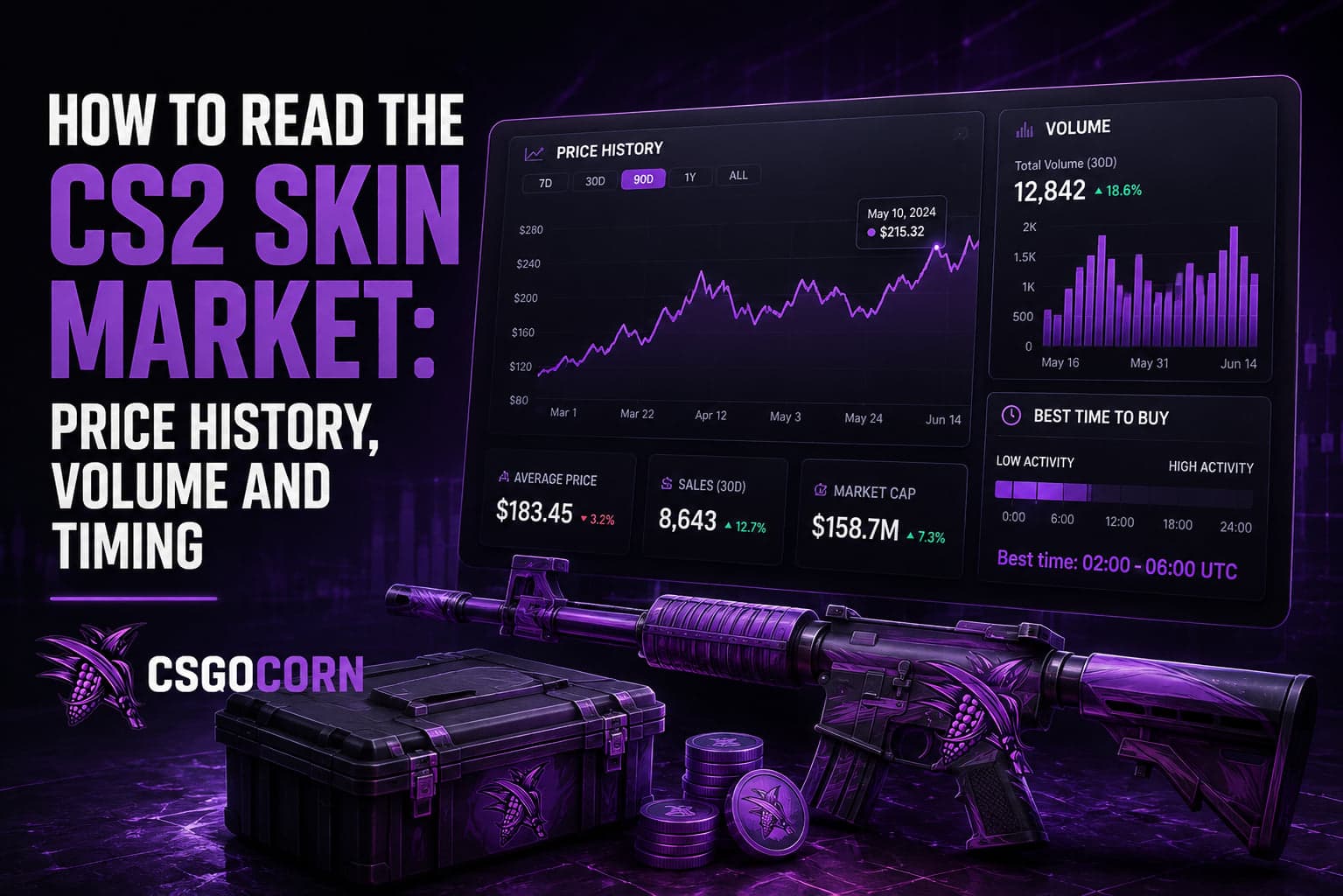
The single most common mistake in skin trading is treating the lowest listed price as "the price". It is not. It is one seller's asking price at one moment on one venue, and it can be well above or below what the item actually changes hands for.
Reading the market properly is not complicated, but it does require looking at two or three things instead of one. This guide covers what those things are and how to interpret them.
Listed price is an offer, not a valuation
A listing tells you what somebody hopes to receive. A sale tells you what somebody actually paid. Those are different numbers and the gap between them varies enormously by item.
For a common skin with dozens of listings and constant turnover, the lowest listing is a decent approximation — the item sells fast enough that asking prices stay honest. For a rare item with three listings and one sale a month, the lowest listing may be pure aspiration.
Always ask: when did one of these last actually sell, and for how much?
Volume is the number most people ignore
Trade volume tells you how liquid an item is, and liquidity determines how much the quoted price is worth to you in practice.
- High volume — many daily sales. Prices are reliable, spreads are tight, you can exit quickly at close to market rate.
- Low volume — occasional sales. The listed price may be far from achievable, and selling can take weeks.
An expensive low-volume item is not "worth" its listing price in any useful sense if nobody is buying at that level. Plenty of inventories are valued on numbers their owners could never realise.
What price history actually shows
A price chart is useful for three things and misleading for a fourth.
Useful: the trend
Is the item drifting up, drifting down or flat over months? This is the strongest signal in the chart and the easiest to read.
Useful: volatility
How far does the price swing week to week? A volatile item needs a wider margin before a flip makes sense.
Useful: reaction to events
Look at what the price did around past case releases, operations and majors. Items respond to the same categories of event repeatedly.
Misleading: short-term spikes
A single unusual sale drags the visible line. One person overpaying is not a new price level, and treating it as one is how people end up holding an item nobody will match.
The events that move the CS2 market
- New case releases. Supply arrives, prices of the new items fall hard from launch highs, and older cases in active rotation shift too.
- Cases leaving active drops. Supply stops growing. This is one of the most consistently price-positive events in the game.
- Operations. Player activity spikes and drop pools change.
- Majors. Sticker and capsule markets move sharply; team stickers are their own market with their own timing.
- Game updates. Changes affecting item appearance or inspection can move a whole finish.
None of these are secret. That is the point — they are predictable, and predictable events are the only kind you can plan around.
Comparing across venues
The same skin has different prices on Steam and on third-party marketplaces, and the gap is structural rather than an arbitrage opportunity. Steam prices include a fee that does not reach the seller, and Steam funds cannot be withdrawn, so Steam prices are effectively quoted in a different currency.
When comparing, normalise to cash-in-hand: what would actually arrive in your account after fees and withdrawal costs? Our comparison of Steam versus third-party marketplaces works through this in detail.
Remember too that Steam does not display float or pattern, so its prices reflect a market where those attributes are invisible. For pattern-sensitive items, Steam price history is close to useless as a valuation guide.
Timing mistakes that cost money
- Buying at hype peaks. The days after a release or a major are when prices are least reliable.
- Ignoring the trade hold. A week of price risk sits between purchase and resale, every time. Our trade hold guide covers the current rules.
- Confusing an illiquid item with a valuable one. Check volume before assuming you can exit.
- Anchoring to what you paid. The market does not know or care about your purchase price.
- Treating skins as savings. The market can fall for reasons entirely unrelated to anything you did.
The spread, and how to price your own listing
Between the highest price a buyer is currently willing to pay and the lowest price a seller is currently asking, there is a gap. That gap is the spread, and it is where the practical cost of trading lives.
On a liquid item the spread is narrow, so buying and selling near market rate is easy. On an illiquid item it can be enormous — a wide spread is the market telling you that buyers and sellers do not agree on what the thing is worth.
When you list something, you are choosing a position inside that spread:
- Undercut the lowest ask and you sell fastest, at the cost of setting a new floor that other sellers will then undercut in turn.
- Match the lowest ask and you join a queue behind everyone already there.
- List above market and you wait — which is only sensible if you have a genuine reason to think the item is underpriced, not merely a wish that it were.
The most expensive habit is undercutting repeatedly out of impatience. Each cut lowers the market you are selling into, and on a thin item a few sellers doing this can move the price meaningfully within a day.
A watchlist beats intuition
People who read the market well are almost never doing it from memory. They are tracking a small set of items over time, which is what turns "this feels expensive" into "this is 15% above where it has sat for three months".
A workable routine, which takes minutes rather than hours:
- Pick ten to fifteen items you actually care about. A watchlist of two hundred is a watchlist you will not read.
- Note the price and the rough sales volume once a week, not once an hour.
- Write down what happened around the events that moved them — a case release, an operation, a major.
- Review the notes before buying, not after.
After a couple of months this produces something no chart gives you: a sense of what normal looks like for the specific items you trade, which is the only baseline that makes "cheap" and "expensive" mean anything.
A practical research routine
Before any significant purchase:
- Check the price trend over several months, not days.
- Check volume — how often does this actually sell?
- Check recent completed sales, not just the lowest listing.
- Compare at least two venues, normalised to cash after fees.
- For pattern-sensitive finishes, compare against the same seed rather than the finish generally.
- Ask what your exit looks like, and how long it takes.
Frequently Asked Questions
Where can I see CS2 skin price history?
Steam shows a price history graph on market listings, and third-party marketplaces and price-tracking tools provide their own data — usually with float and pattern detail Steam does not display.
Why is the same skin cheaper on a third-party site?
Different fee structures, and the fact that Steam funds cannot be withdrawn. Compare what actually reaches your account rather than the headline figures.
Do CS2 skins always go up in value?
No. Plenty of items have fallen and stayed down. Supply changes, shifting fashion and game updates all push prices in both directions.
When is the best time to buy skins?
There is no reliable universal answer, but buying into a hype peak is consistently the worst timing. Quiet periods away from releases and majors tend to be calmer.
Is trade volume more important than price?
For deciding whether you can actually sell, yes. A high price on an item that rarely trades is not money you can access on demand.
The short version
Listings are offers, sales are prices, and volume tells you which of the two to believe. Read trends over months rather than days, expect the predictable events to do predictable things, and always normalise across venues to what actually lands in your account.
Ready to pick one? We tested and ranked the CS2 gambling sites — deposits, payouts, bonus terms and all.
See the tested CS2 gambling sitesRelated posts
How to Spot a CS2 Skin Scam: Red Flags Every Trader Should Know
Skin scams work because they exploit urgency and trust, not technical weaknesses. This guide breaks down the API key hijack, the fake middleman, the impersonated marketplace and the quick-swap, plus the habits that make you a hard target.
CS2CS2 Skin Patterns Beyond Blue Gem: Fade, Doppler, Marble Fade and Case Hardened
Pattern index is the hidden number that turns an ordinary skin into a four-figure one. This guide explains how pattern seeds work, what makes a high Fade percentage, how Doppler phases are priced, and which patterns are worth hunting.
CS2CS2 Gloves Explained: Every Glove Type, Which Cases Drop Them, and What Drives the Price
Gloves share the same 0.26% gold tier as knives but behave very differently on the market. This guide covers every glove type in CS2, which cases actually contain them, why wear matters more on gloves than on any weapon, and how to buy without overpaying.