
CS2 Case Opening Odds: The Real Numbers Behind Every Unbox
 CornieEditor & Lead ReviewerAugust 4, 2026 7 min read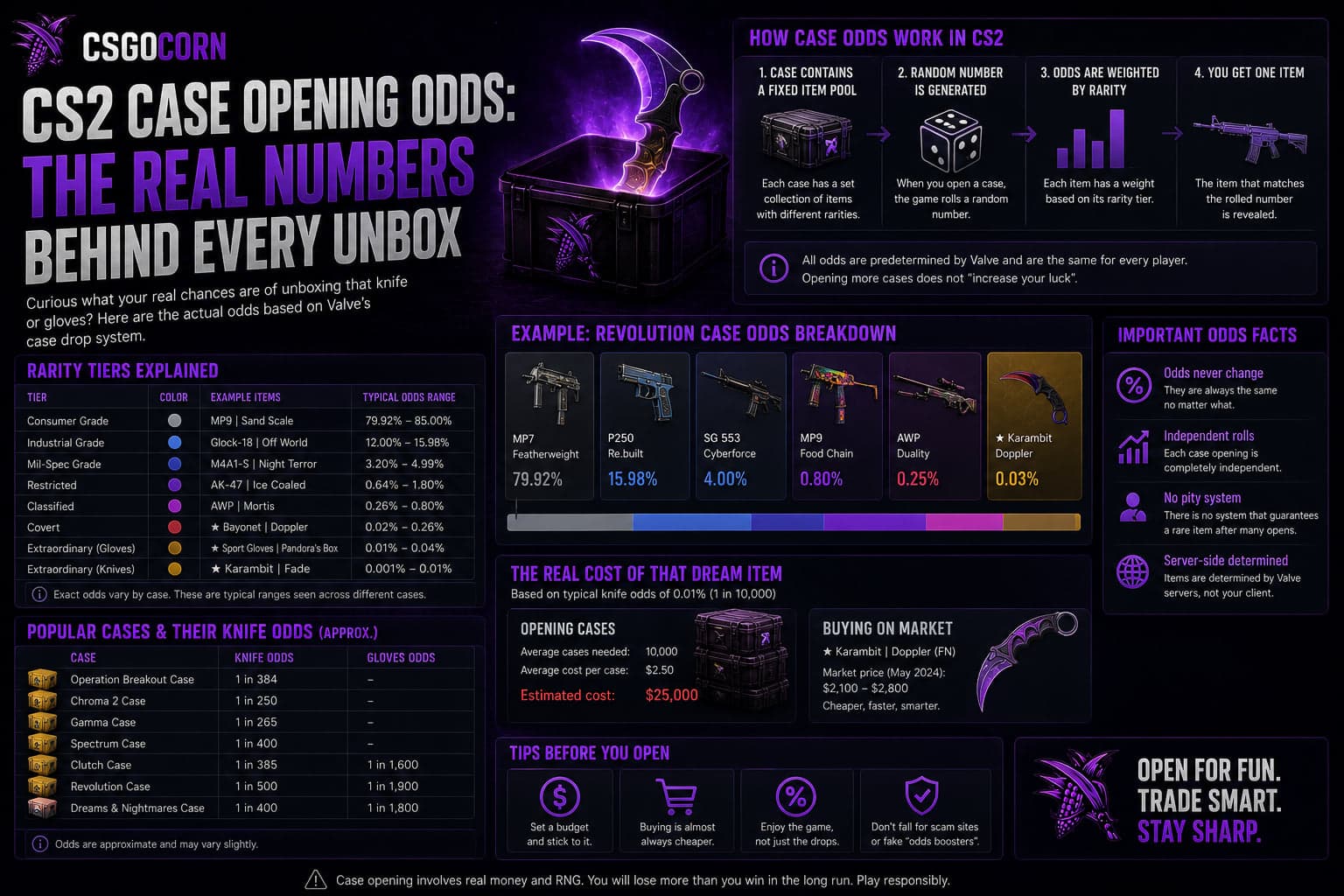
Case opening is the most visible form of gambling in Counter-Strike, and it is also the one where the odds are least hidden. Valve publishes the drop rates. They are the same for every weapon case in the game, and once you see them written down, a lot of the folklore around "due" cases and "lucky" accounts stops being persuasive.
This guide lays out the real numbers, works through what they mean over realistic volumes, and explains how the maths shifts when you move from Steam cases to third-party sites. It is written for people who want to make an informed decision, not to talk anyone into or out of opening cases.
The published drop rates
Every standard CS2 weapon case uses the same rarity distribution:
- Mil-Spec (blue) — 79.92%
- Restricted (purple) — 15.98%
- Classified (pink) — 3.20%
- Covert (red) — 0.64%
- Rare Special Item (gold — knives and gloves) — 0.26%
On top of that, any weapon skin has roughly a 10% chance of being StatTrak. The rarity roll and the StatTrak roll are separate events.
Read the top line again: roughly four openings in five return the cheapest tier in the case. That is not a bad-luck streak, that is the design.
Turning percentages into intuition
Percentages that small are hard to feel, so convert them:
- A gold item at 0.26% is about 1 in 385 openings.
- A Covert at 0.64% is about 1 in 156.
- A Classified at 3.20% is about 1 in 31.
At 1 in 385, opening 385 cases does not guarantee a knife. It gives you roughly a 63% chance of having seen at least one. Nearly four people in ten who open that many will still be empty-handed on golds, and that is the expected outcome, not a glitch.
The gambler's fallacy, stated plainly
Each case is an independent event. A case that has been "dry" for 200 openings has exactly the same 0.26% gold chance as the first one you ever opened. There is no accumulating pity counter in the Steam case system, no account-level luck, and no benefit to opening at a particular time of day.
This is worth internalising because the opposite belief is expensive. "I am due" is the single most reliable way to turn a fixed budget into a larger one.
Expected value: why the maths does not favour you
Expected value is the average outcome per opening if you repeated it indefinitely. For Steam cases it is negative, and the size of the gap depends on the case: the key costs a fixed amount, most outcomes are worth a fraction of it, and the rare outcomes that pay are rare precisely in proportion to how much they pay.
Two structural drags make it worse than the raw skin values suggest:
- Market fees. Selling an unboxed skin on the Steam Community Market takes a cut, so the number you see on the listing is not the number that reaches your wallet.
- Trade cooldowns. A freshly unboxed item is not instantly liquid. Price can move against you while you wait.
None of this means nobody profits. Some people do, in the same way some people win a hand of blackjack. It means the average participant, over enough openings, loses — and the design guarantees it.
How third-party case sites change the equation
Third-party CS2 case opening sites run their own cases with their own item pools and their own odds, which are not Valve's published numbers. The good ones disclose the odds per item and let you verify the outcome. That verification is the whole point of provably fair systems, and if you have not read how they work, our guide to provably fair verification covers the mechanics.
What to check before you open anything on a third-party site:
- Are per-item odds displayed? A site that shows the item pool but hides the probability is asking you to trust a number you cannot see.
- Is there a provably fair seed you can verify after the fact? Not a badge saying "provably fair" — an actual seed pair and a hash you can check.
- What is the withdrawal path? A win you cannot withdraw is not a win. Payout speed and limits matter more than the flashy case list.
Every site we list has been through this on our side; the process is written up on our testing methodology page.
Case battles and the odds
Case battles do not improve your drop rates. They change the payout structure: several people open the same cases and the highest total takes everything. Your per-case probability is unchanged; what changes is variance, which goes up sharply. You either take multiple people's openings or lose your own.
If you enjoy battles for the format, that is a legitimate reason to play them. Just do not treat the format as an edge — our case battle strategy guide goes through the formats in detail.
The StatTrak roll is a separate lottery
Roughly one weapon skin in ten comes out StatTrak, and that roll happens independently of the rarity roll. It does not improve or worsen your chance of a gold, and a gold knife has its own separate StatTrak possibility where applicable.
The practical effect is on value rather than odds. A StatTrak version of a desirable Covert can be worth substantially more than the plain version, which widens the gap between a good opening and an average one. It also widens the variance, which is worth remembering when you look at someone's highlight clip: you are seeing the tail of two stacked lotteries, not a typical result.
Souvenir packages work differently
Souvenir packages are not weapon cases and do not follow the rates above. They come from watching or attending tournaments rather than from drops plus a key, and their contents carry tournament stickers applied to the skin. Because the supply is tied to a specific event that has already happened, souvenir supply is fixed rather than growing.
That fixed supply is why some souvenir items appreciate in a way ordinary case items rarely do — and why comparing a souvenir price against a normal one tells you very little. They are separate markets that happen to share a weapon model.
Why "which case should I open" is the wrong question
The rarity odds are identical everywhere, so the only variable between cases is what sits inside each tier. A case whose gold pool contains expensive knives has a better payout profile than one whose gold pool does not, at the same 0.26% chance.
That still does not make it profitable. It changes how much you get back in the rare event you win, not how often you win. The realistic framing is: choose the case whose items you would actually want to own, because owning them is the only outcome under your control.
Setting a budget that survives contact with reality
The only variable you fully control is how much you spend. A workable approach:
- Decide the number before you start, and treat it as spent the moment you begin.
- Never fund openings by selling items you would be upset to lose.
- Count the money you put in, not the value of what came out — inventories are very good at hiding losses behind a couple of memorable pulls.
Frequently Asked Questions
Are CS2 case odds the same for every case?
Yes. The rarity distribution is identical across standard weapon cases. What differs is the value of the items inside each tier, which is what makes some cases better or worse value than others.
What are the odds of getting a knife in CS2?
0.26% per case, or roughly 1 in 385. Gloves share that same gold tier in the cases that contain them.
Does opening more cases at once improve my chances?
No. Every case is independent. Opening a hundred in a row gives you a hundred separate 0.26% chances, not a rising one.
Is it cheaper to buy the skin than to unbox it?
Almost always, yes. If you want one specific skin, buying it directly on a marketplace costs less on average than trying to unbox it. Opening cases makes sense as entertainment, not as procurement.
Are third-party case sites' odds the same as Steam's?
No. They set their own item pools and probabilities. Only open on sites that publish per-item odds and offer verifiable provably fair results.
The short version
Four openings in five return the cheapest tier. Knives sit at 1 in 385 and never become "due". Expected value is negative before fees and cooldowns, and negative by a wider margin after them. Open cases because you enjoy opening cases, with money you have already decided to spend.
18+. Gambling carries real financial risk and can be addictive. Only play with money you can afford to lose.
Ready to pick one? We tested and ranked the CS2 gambling sites — deposits, payouts, bonus terms and all.
See the tested CS2 gambling sitesRelated posts
How to Read the CS2 Skin Market: Price History, Volume and Timing
Most people check one price and call it research. This guide covers what a price chart actually tells you, why trade volume matters more than the headline number, the events that move the market, and how to avoid the mistakes that cost traders money.
CS2How to Spot a CS2 Skin Scam: Red Flags Every Trader Should Know
Skin scams work because they exploit urgency and trust, not technical weaknesses. This guide breaks down the API key hijack, the fake middleman, the impersonated marketplace and the quick-swap, plus the habits that make you a hard target.
CS2CS2 Skin Patterns Beyond Blue Gem: Fade, Doppler, Marble Fade and Case Hardened
Pattern index is the hidden number that turns an ordinary skin into a four-figure one. This guide explains how pattern seeds work, what makes a high Fade percentage, how Doppler phases are priced, and which patterns are worth hunting.