
CS2 Float and Wear Explained: The Number Behind Every Skin's Price
 CornieEditor & Lead ReviewerJuly 24, 2026 8 min read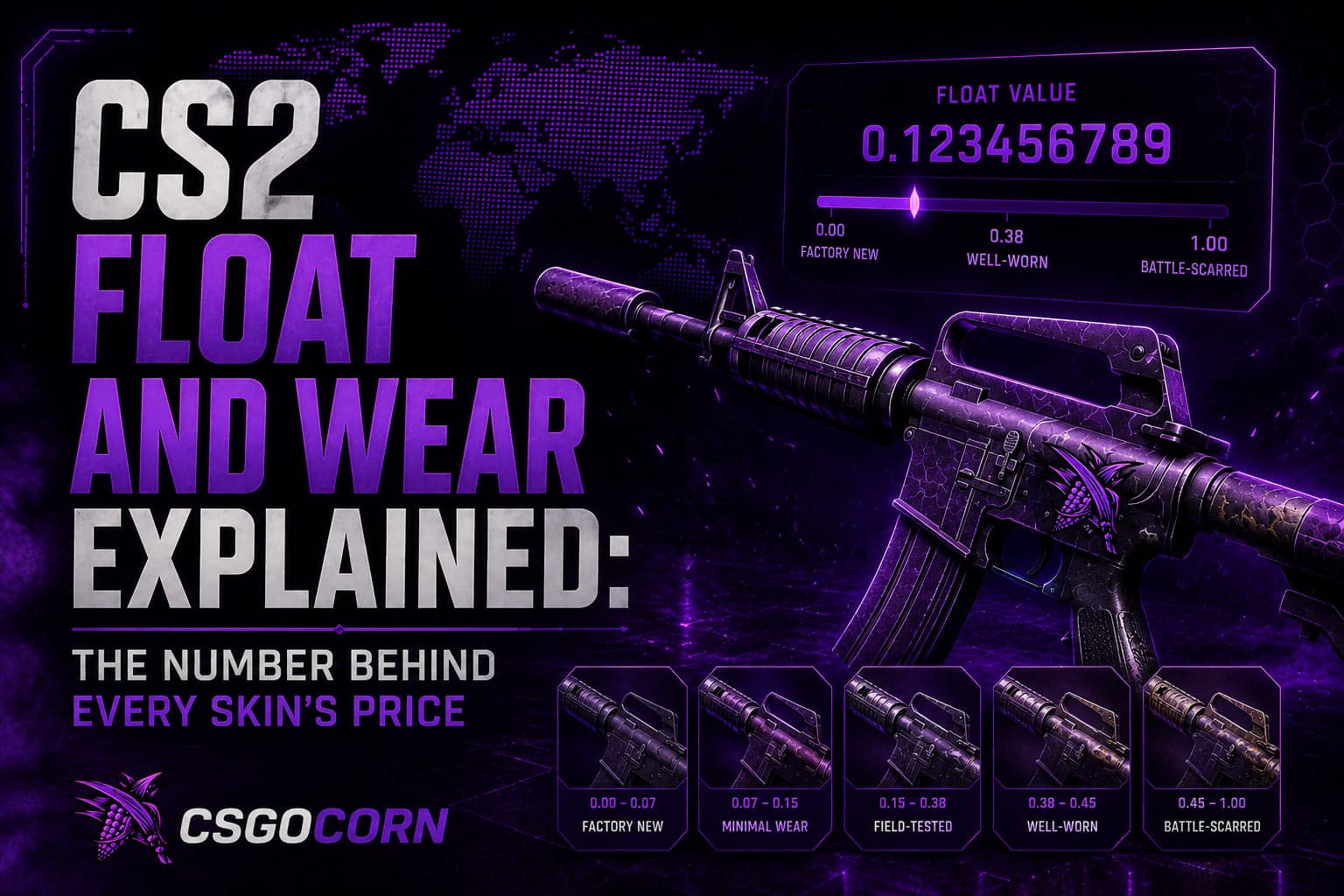
Two copies of the same CS2 skin can differ in price by hundreds of dollars, and to a new player nothing about them looks different. The reason is float — a hidden number that decides how worn a skin looks and, through that, a large part of what it is worth. Understanding float is the single most useful thing you can learn about the CS2 skin economy, because it is the factor most beginners ignore and the one experienced traders quietly build their margins on.
This guide explains what float actually is, how it maps to the wear names you see in-game, why it moves prices the way it does, and how to check it before you buy, sell, or feed skins into a trade-up. It is about understanding value, not chasing it — skin prices move, and nothing here is investment advice.
What float value actually is
Every CS2 skin carries a hidden decimal number between 0 and 1 called its float value, or "wear value." It is generated when the skin is created and never changes afterwards — a skin does not degrade as you use it, despite how it looks. The lower the number, the cleaner and less worn the skin appears; the higher the number, the more scratched and faded it looks.
That single number is what the wear category names are built on. When the game calls a skin "Factory New" or "Battle-Scarred," it is just translating the underlying float into a human-readable band. The float is the real value; the wear name is a label sitting on top of it.
The five wear categories
CS2 divides the 0–1 float range into five named tiers:
- Factory New — float 0.00 to 0.07. The cleanest tier, and usually the most expensive.
- Minimal Wear — float 0.07 to 0.15. Very light wear, still crisp on most skins.
- Field-Tested — float 0.15 to 0.38. The widest and most common tier; where most affordable skins live.
- Well-Worn — float 0.38 to 0.45. Noticeably faded, and often the least liquid tier.
- Battle-Scarred — float 0.45 to 1.00. The most worn, and usually the cheapest.
Notice how uneven those bands are. Factory New spans just 0.07 of the range while Battle-Scarred spans more than half of it. That imbalance matters, and it is the root of several float quirks below.
Why float moves prices
Price generally rises as float falls, but not smoothly — it jumps at the boundaries. A skin at float 0.149 is "Minimal Wear" and a skin at 0.151 is "Field-Tested," and even though the difference in appearance is invisible, the price can drop noticeably just from crossing that named line. The market prices the label, not only the underlying number.
Three things make float valuable:
- Cleaner looks. Most players simply prefer a crisp skin, so lower floats carry a premium within every tier.
- Scarcity at the extremes. Very low floats are rarer to roll, so a near-perfect Factory New sells above an ordinary one.
- Pattern interaction. On some finishes, low wear reveals more of the design, which stacks with float to push value higher.
Extreme floats: the collector premium
At the very edges of the scale, float stops being about the wear tier and becomes a collector's item in itself. The lowest possible Factory New floats — think 0.00x — and the highest possible Battle-Scarred floats can both sell for large premiums over a normal copy, precisely because they are hard to roll and fun to own. The same skin can be worth many times more at an extreme float than in the middle of its range.
The detail that catches everyone: skins have their own float caps
Here is the part that trips up almost every newcomer. Not every skin can reach every wear tier. Each skin has its own minimum and maximum float baked into it, and those caps override the standard bands.
Some skins have a minimum float above 0.00, so they can never be a true pristine Factory New. Others have a maximum float below 1.00 — or even below 0.45 — so they can never be Battle-Scarred, and every copy is relatively clean. A skin capped at, say, 0.40 maximum will never exist in the worst tier at all.
The practical takeaway: before you value any skin by its wear name alone, check its actual float range. "Factory New" on a skin with a 0.00 minimum is a very different item from "Factory New" on a skin whose range starts higher. This is also why the wear you see on a marketplace listing does not tell the whole story on its own.
Float and trade-up contracts
Float becomes genuinely important the moment you touch trade-up contracts, because the wear of the output is not random — it is calculated from the inputs. The output float is the average of your ten input floats, mapped onto the output skin's own float range. Feed in cleaner skins and you get a cleaner result; feed in worn ones and you get a worn result.
That makes low-float inputs a tradeable resource in their own right, and it means a trade-up aimed at a Factory New output can fail simply because the chosen output skin's float range does not allow Factory New at all. We cover the full mechanic in our CS2 trade-up guide, but the short version is: you cannot understand trade-ups without first understanding float.
How to check a skin's float
You do not have to guess. There are a few reliable ways to see the exact number:
- In-game inspect. Inspecting a skin shows its wear, and CS2 exposes the precise float on inspection.
- Float-checker tools. Paste an item's inspect link into a well-known float-checking site and it returns the exact float and pattern index. Third-party CS2 marketplaces often show the float right on the listing, which is one of their advantages over the basic Steam Market view.
- Marketplace filters. The better marketplaces let you filter or sort by float, so you can find a specific wear boundary or a low-float copy directly.
Whenever you are about to spend real money on a knife, gloves, or a high-tier rifle, checking the float takes thirty seconds and is the highest-value habit in skin trading.
Common float mistakes
- Judging by wear name alone. Two "Field-Tested" copies can differ a lot in both look and price depending on where they sit in the 0.15–0.38 band.
- Ignoring per-skin caps. Assuming every skin can be Factory New leads to overpaying and to failed trade-ups.
- Overpaying for a marginal float. The visual difference between 0.006 and 0.015 is essentially nil; the price difference may not be. Decide whether you are buying to admire or to resell.
- Forgetting fees on the flip. A low-float copy bought to resell still has to clear the marketplace fee before it profits.
Frequently Asked Questions
What is a good float value in CS2?
Lower is generally better within any wear tier, but "good" depends on your goal. For looks, anything comfortably inside Factory New or Minimal Wear is clean. For value, the premiums concentrate at the extremes — the very lowest floats — and just past a wear boundary, where a skin looks like the tier above but is priced closer to the tier below.
Does float value change over time?
No. A skin's float is set when it is created and is fixed forever. Using the skin does not wear it down — the worn look is cosmetic and does not alter the number.
Why is one Factory New more expensive than another?
Because their exact floats differ. A Factory New at 0.003 is rarer and cleaner than one at 0.065, so it sells for more even though both share the same wear name. Pattern index can add another layer on certain finishes.
Can every CS2 skin be Factory New?
No. Each skin has its own minimum and maximum float. If a skin's minimum is above 0.07, it can never be a true Factory New, no matter how the market lists it.
How do I find out a skin's exact float?
Inspect it in-game, paste its inspect link into a reputable float-checker tool, or buy from a marketplace that displays the float on the listing. Never rely on the wear name alone for a high-value purchase.
Does float matter for trade-up contracts?
Yes, a lot. The output's wear is the average of your input floats mapped onto the output skin's own range, so float directly controls what you get — and some outputs cannot reach Factory New at all.
Conclusion
Float is the number underneath everything else in the CS2 skin market: it decides how a skin looks, it drives price jumps at every wear boundary, and it is the mechanic that makes trade-up contracts predictable. Learn to read it, always check a skin's real float range rather than trusting the wear name, and you will stop overpaying and start spotting the value that most buyers walk straight past.
None of that makes skins a safe bet. Prices swing, liquidity at the extremes can be thin, and a "worth it on paper" flip still has to survive fees and time. Buy skins you would be happy to own, verify before you trade, and if any part of how you play involves skin gambling, keep it to money you are comfortable losing — it is strictly for players aged 18 and over.
Ready to pick one? We tested and ranked the CS2 gambling sites — deposits, payouts, bonus terms and all.
See the tested CS2 gambling sitesRelated posts
How to Read the CS2 Skin Market: Price History, Volume and Timing
Most people check one price and call it research. This guide covers what a price chart actually tells you, why trade volume matters more than the headline number, the events that move the market, and how to avoid the mistakes that cost traders money.
CS2How to Spot a CS2 Skin Scam: Red Flags Every Trader Should Know
Skin scams work because they exploit urgency and trust, not technical weaknesses. This guide breaks down the API key hijack, the fake middleman, the impersonated marketplace and the quick-swap, plus the habits that make you a hard target.
CS2CS2 Skin Patterns Beyond Blue Gem: Fade, Doppler, Marble Fade and Case Hardened
Pattern index is the hidden number that turns an ordinary skin into a four-figure one. This guide explains how pattern seeds work, what makes a high Fade percentage, how Doppler phases are priced, and which patterns are worth hunting.