
CS2 Trade-Up Contracts Explained: Odds, Float Maths and Real Profit
 CornieEditor & Lead ReviewerJuly 22, 2026 9 min read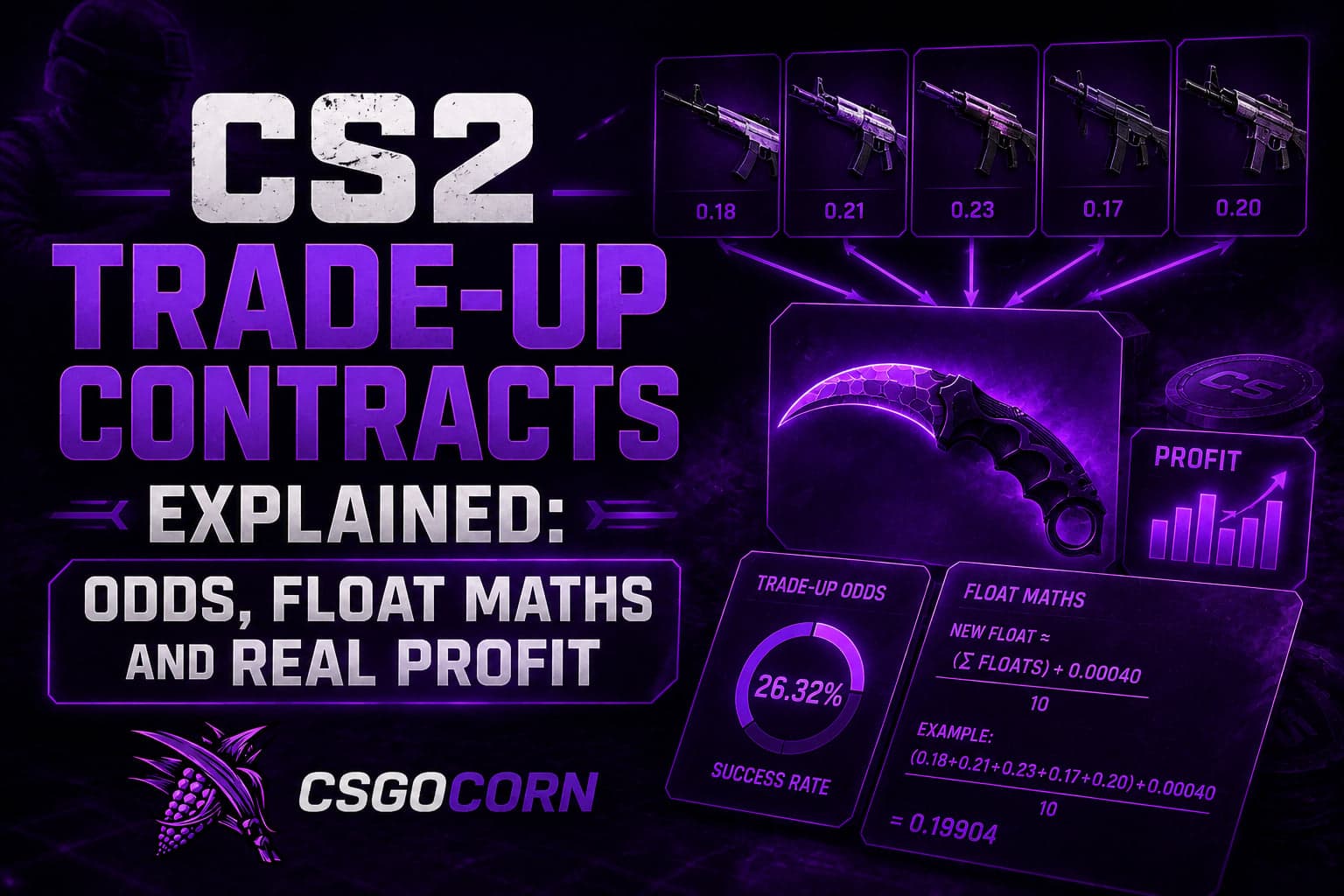
The trade-up contract is the one part of the CS2 economy that runs on arithmetic rather than luck alone. Ten skins go in, one comes out, and unlike opening a case you can calculate the exact odds and the exact wear of the result before you commit a single item. That makes it the most transparent gamble in the game — and, for the same reason, the one where most people lose money without ever understanding why.
This guide covers how the contract actually works, the two formulas that decide your outcome, how to read a trade-up's expected value, and the specific mistakes that turn a "guaranteed profit" spreadsheet into a loss. None of it is a way to beat the market reliably; it is a way to stop paying for the parts you did not understand.
What a trade-up contract is
A trade-up contract takes ten skins of the same rarity and returns one skin of the next rarity up. Ten Mil-Spec (blue) skins produce one Restricted (purple), ten Restricted produce one Classified (pink), ten Classified produce one Covert (red). Covert is the ceiling — there is no trade-up that outputs a knife or gloves, and anyone telling you otherwise is selling something.
The rules on the inputs are strict:
- All ten must be the same rarity tier. You cannot mix blues and purples.
- All ten must be either all StatTrak or all non-StatTrak. A StatTrak contract produces a StatTrak result, drawn only from StatTrak-eligible collections.
- Souvenir skins cannot be used at all.
- The ten can come from different collections, and this is the lever that everything else turns on.
That last point is what makes trade-ups interesting. The outcome is not "a random skin from the game" — it is drawn from a pool built out of the collections you fed in.
How the odds are calculated
Every input skin contributes one entry for each possible outcome in its own collection's next rarity tier. Add those up across all ten inputs and you have the total ticket pool; every ticket is equally likely.
In practice that produces a simple rule. If you put in n skins from a collection that has k possible outcomes at the tier above, then:
- The chance of one specific skin from that collection is n divided by the total ticket count.
- The chance of getting anything from that collection is n × k divided by the total ticket count.
A worked example
Say you use five inputs from Collection A, which has two outcomes at the next tier, and five from Collection B, which has five outcomes. Collection A contributes 5 × 2 = 10 tickets. Collection B contributes 5 × 5 = 25 tickets. The pool is 35.
Each specific Collection A skin holds 5 of those 35 tickets — about 14.3% each, 28.6% for the pair. Each specific Collection B skin holds 5 of 35 as well, but there are five of them, so Collection B takes 71.4% overall.
The lesson is counter-intuitive and worth internalising: collections with fewer outcomes concentrate your odds. Ten inputs from a collection with a single next-tier skin is a 100% guaranteed outcome. Collections that are wide dilute every individual chance. CS2 shows you the full outcome list with percentages in the contract preview before you confirm — read it every time, because a collection you assumed was narrow may not be.
The float formula — the part most people get wrong
Wear is not random in a trade-up. It is fully determined before you click, by this relationship:
Output float = average input float × (output's max float − output's min float) + output's min float
The average is a plain average of the ten input float values. That average is then treated as a position on the output skin's own wear scale.
Two consequences follow, and they cost people real money:
Every skin has its own float range
Skins do not all run from 0 to 1. Plenty are capped — a skin with a range of 0.10 to 0.70 can never be Factory New no matter how pristine your inputs are, and a skin with a minimum of 0.45 will always be Well-Worn or worse. Before buying a single input, check the output's actual range. A trade-up built to hit Factory New on a skin that cannot reach Factory New is money set on fire.
Different outcomes land on different wears
Because each possible output has its own min and max, a single average input float can produce a Factory New from one outcome and a Field-Tested from another in the same contract. Your expected value calculation has to price every outcome at the wear that outcome will actually land on, not at the wear you are hoping for. This is the single most common error in homemade trade-up spreadsheets.
Working out whether a trade-up is worth it
The maths is not complicated. Multiply each outcome's probability by what that outcome sells for at the wear it will land on, add them together, and compare to what the ten inputs cost you.
Then subtract the parts people forget:
- Marketplace fees on the sale. Steam takes roughly 15%, which turns a lot of thin-margin contracts negative on its own. Third-party marketplaces charge less, which is one reason serious traders sell there — we cover the trade-offs in our CS2 marketplace guide.
- The spread on the inputs. The lowest listing is not the price you will pay for ten of something, especially at a specific float.
- The float premium. Low-float inputs are not priced like ordinary copies. If your contract needs an average of 0.04, you are competing with every other trade-up crafter for the same scarce items.
- Time. A profitable-on-paper output that takes three weeks to sell is a worse trade than a smaller margin that clears the same day.
Run that honestly and you will find that most publicly discussed trade-ups are slightly negative. That is not a coincidence. Trade-up calculators are free and widely used, so any clearly profitable contract gets crafted repeatedly until the input prices rise and the edge closes. Persistent profit lives in mispriced corners — a collection nobody is watching, a float band that is briefly cheap — and it does not last.
Where real edges come from
Narrow collections
Fewer outcomes at the next tier means a higher chance on each. A contract concentrated in a narrow collection with one strong outcome beats a scattered one with a lottery ticket in it.
Buying the wear boundary
Prices jump at wear names, but float is continuous. A 0.151 float sits at the very top of Field-Tested and often sells barely above a 0.38 copy, while it behaves almost like a Minimal Wear inside your contract's average. Buying just past a boundary is one of the few genuine, repeatable edges available.
StatTrak asymmetries
StatTrak input pools are smaller and thinner, which cuts both ways: inputs can be overpriced relative to demand, but outputs can also be scarce enough to carry a real premium. It is worth checking rather than assuming.
Patience on the inputs
Most of the margin in a good trade-up is captured when you buy, not when you craft. Setting buy orders slightly under market and waiting beats sweeping the cheapest listings.
Mistakes that quietly cost money
- Pricing every outcome at Factory New. Check each outcome's own float range.
- Ignoring fees. A 10% paper margin is a loss after a 15% sale fee.
- Using median price instead of the actual sell price. Median lags; what matters is what you can realistically get today.
- Trusting a screenshot. If someone posts a "guaranteed profit" contract, the inputs have usually already been bid up by the time you read it.
- Skipping the in-game preview. CS2 shows the real outcome list and odds before you confirm. If the preview disagrees with your spreadsheet, the preview is right.
- Treating a series of small trade-ups as risk-free. Variance is real. A contract with an 8% chance at the good outcome will lose eleven times in a row often enough to hurt.
Trade-ups versus case opening and upgraders
Compared to opening cases, trade-ups are clearly the more transparent option: the odds are visible, the wear is deterministic, and there is no key cost. Compared to the upgraders and case battles found on CS2 gambling sites, they carry no house edge at all — the only friction is marketplace fees and your own valuation errors.
That does not make them safe. It makes the risk honest. You are still converting a certain amount of value into an uncertain one, and the variance on a single contract is large. Where a site is involved rather than the in-game contract, the usual questions apply — verifiable odds, a payout record, real support — and that is exactly what our site reviews are there to answer.
Frequently Asked Questions
How many skins do you need for a CS2 trade-up?
Exactly ten, all of the same rarity tier and all either StatTrak or all non-StatTrak. They can come from different collections.
Can you trade up to a knife or gloves in CS2?
No. Covert is the highest tier a trade-up can produce. Knives and gloves are only obtainable from cases, trades or the market.
How is the wear of a trade-up result decided?
It is calculated, not rolled. The average float of your ten inputs is mapped onto the output skin's own float range: average × (max − min) + min. Since each possible output has a different range, the same inputs can land on different wears depending on which skin you receive.
Are trade-up contracts profitable?
Sometimes, but rarely for long. Free calculators mean profitable contracts get crafted until input prices rise and the margin disappears. After marketplace fees, most widely known trade-ups are slightly negative expected value.
Can you use Souvenir skins in a trade-up?
No. Souvenir items are excluded entirely. Only ordinary and StatTrak skins are eligible, and StatTrak contracts must be all StatTrak.
Why did my trade-up produce a worse wear than expected?
Almost always because the outcome you received has a different float range than the one you planned around. A skin whose range starts at 0.15 cannot be Factory New however clean your inputs were.
Does a more expensive input improve the odds?
No. Price has no effect on the outcome. Only the collections your inputs come from affect the odds, and only their float values affect the wear.
Conclusion
Trade-up contracts reward the small amount of homework almost nobody does: check each outcome's float range, price every outcome at the wear it will actually land on, count the fees, and read the in-game preview before confirming. Do that and you will stop losing money to arithmetic errors, which is most of what separates people who break even from people who do not.
What it will not do is make you money reliably. The visible edges close quickly, the variance on any single contract is significant, and a run of bad outcomes is normal rather than unlucky. Treat trade-ups as an entertaining, transparent bet on skins you would be happy to own anyway, only commit value you are comfortable losing, and remember that skin trading and gambling are strictly for players aged 18 and over.
Ready to pick one? We tested and ranked the CS2 gambling sites — deposits, payouts, bonus terms and all.
See the tested CS2 gambling sitesRelated posts
How to Read the CS2 Skin Market: Price History, Volume and Timing
Most people check one price and call it research. This guide covers what a price chart actually tells you, why trade volume matters more than the headline number, the events that move the market, and how to avoid the mistakes that cost traders money.
CS2How to Spot a CS2 Skin Scam: Red Flags Every Trader Should Know
Skin scams work because they exploit urgency and trust, not technical weaknesses. This guide breaks down the API key hijack, the fake middleman, the impersonated marketplace and the quick-swap, plus the habits that make you a hard target.
CS2CS2 Skin Patterns Beyond Blue Gem: Fade, Doppler, Marble Fade and Case Hardened
Pattern index is the hidden number that turns an ordinary skin into a four-figure one. This guide explains how pattern seeds work, what makes a high Fade percentage, how Doppler phases are priced, and which patterns are worth hunting.