
Rust Gambling Sites Explained: Game Types, Odds and How to Spot a Safe One
 CornieEditor & Lead ReviewerJuly 18, 2026 9 min read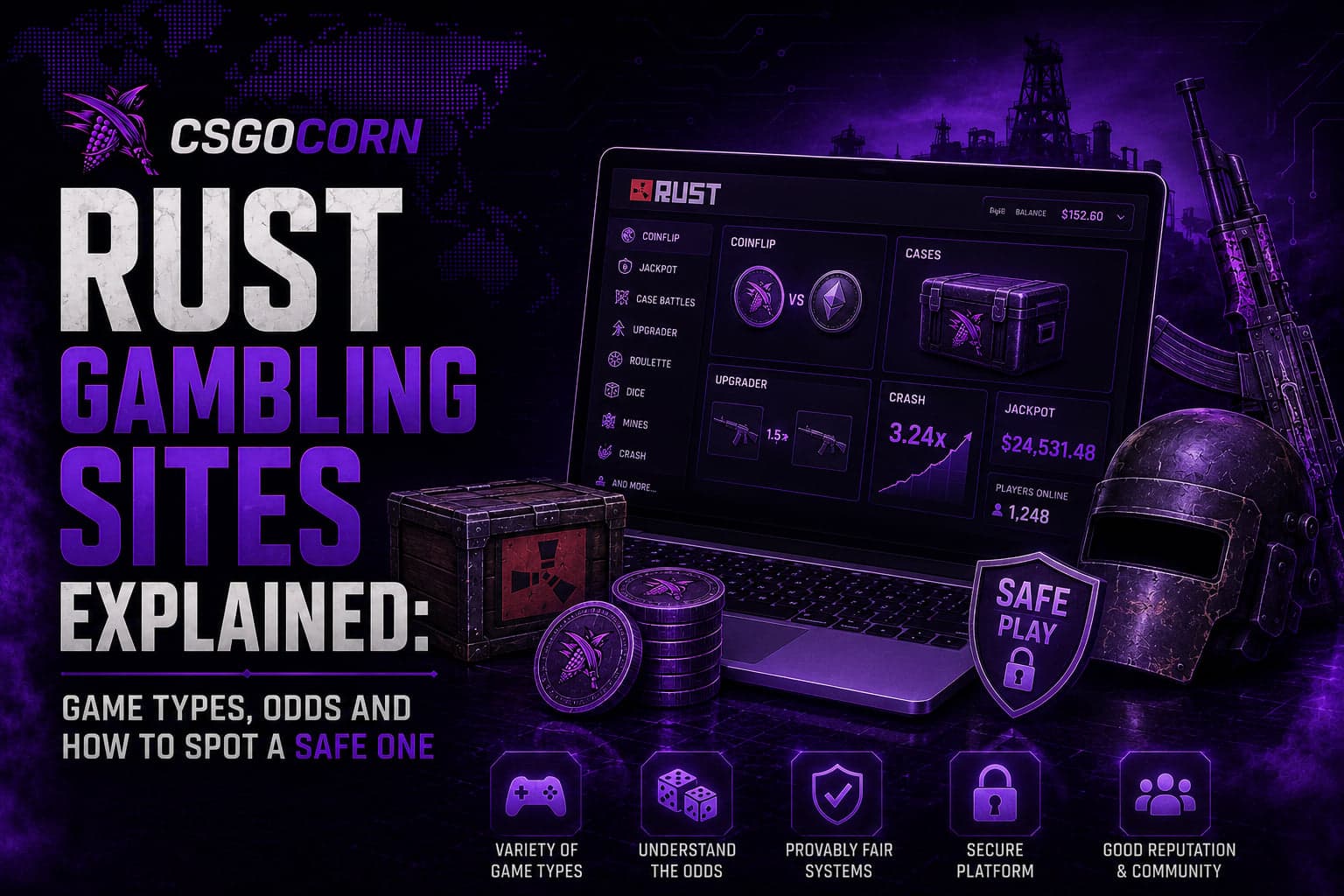
Rust has one of the most active skin gambling scenes in PC gaming. Skins are cheap enough to feel disposable, the community is comfortable with risk, and dozens of sites will happily take your deposit. That combination makes it easy to lose track of what you are actually playing — and easy to end up on a platform that has no intention of paying you.
This guide walks through what Rust gambling sites are, the game modes you will find on them, how the maths behind those games actually works, and the concrete checks that separate a legitimate site from one to close immediately. It is written to help you make an informed decision, not to encourage you to gamble. If you do play, treat every deposit as money already spent.
What is a Rust gambling site?
A Rust gambling site accepts Rust skins as a deposit, converts them into an internal balance (usually coins), and lets you stake that balance on games of chance. Win, and you withdraw skins back to your Steam inventory. These platforms are not affiliated with Facepunch, and the skins never technically leave the Steam ecosystem — they simply move between your account and the site's bot inventory.
Most modern sites also accept cryptocurrency and sometimes card deposits alongside skins, which blurs the line between a Rust gambling site and a general crypto casino. The core proposition is the same: deposit value, play, hopefully withdraw more than you put in — knowing that mathematically, over time, most players will not. We rank the current platforms on our Rust gambling sites page.
The game types you will encounter
Jackpot
Players deposit skins into a shared pot and one winner takes everything. Your chance of winning equals your share of the pot's total value. Deposit $10 into a $100 pot and you have a 10% chance. It feels social and dramatic, and it is one of the oldest formats in skin gambling.
Roulette
Usually a simplified three-colour wheel: two common colours paying 2x and a rare colour paying 14x. Simple, fast, and where most bankrolls quietly disappear because the round takes fifteen seconds.
Coinflip
Head-to-head, roughly 50/50 minus the site's cut. The cleanest odds on most sites and the easiest to understand, which is exactly why it is popular.
Crash
A multiplier climbs from 1x and can stop at any moment. Cash out before it crashes and you keep the multiplier; leave it too long and you lose the stake. It rewards discipline more than any other mode, which is also why it punishes tilt so severely.
Case opening and free cases
Site-run cases containing Rust skins at various rarities. Many platforms give away free daily cases to logged-in users as a retention mechanic. These are genuinely free value, but the expected return per case is small and the point of them is to bring you back.
Wheel, dice, plinko and upgraders
Variations on the same idea: pick a risk level, accept a corresponding payout multiplier. The upgrader is worth calling out — it lets you gamble a skin for a chance at a more valuable one, and the displayed percentage is exactly what it says. A 20% upgrade fails four times in five.
How the odds really work
Every one of these games carries a house edge, which is the gap between the true odds of an outcome and what the site pays for it. On a three-colour roulette, the rare colour might hit one time in fifteen but pay only 14x. That difference is the site's revenue, and it applies to every single bet you place.
Two consequences follow, and they are not negotiable. First, no betting system fixes it — doubling after a loss changes the shape of your results, not their expected value, and it runs into table limits and your own balance long before it runs into luck. Second, the more rounds you play, the closer your results converge on the house edge. Short sessions are the only thing variance reliably rewards.
Understanding this does not make you win. It does stop you from believing a losing streak is "due" to end, which is the belief that empties accounts.
Provably fair: what it does and does not prove
Provably fair is a cryptographic system that lets you verify a round was not manipulated after the fact. In simple terms the site commits to a result in advance by publishing a hash of a server seed, your client seed is mixed in, and after the round both seeds are revealed so you can re-run the calculation yourself and confirm the outcome matches.
What it proves: the specific roll you played was not rigged against you retroactively. What it does not prove: that the house edge is reasonable, that the site is solvent, or that it will process your withdrawal. A provably fair site can still be a bad site. Treat verifiable results as a minimum requirement rather than a seal of approval, and read our explainer on how provably fair verification works if you want to check a roll yourself.
Deposits and withdrawals
Skin deposits are valued using the site's own pricing, which will not match the Steam Market exactly — expect a spread, and check it before depositing anything valuable. Withdrawals come back as skins from the site's bot inventory, which introduces a practical problem: if the inventory is thin, you may be unable to withdraw the value you hold in a form you actually want.
Crypto withdrawals sidestep that entirely and are usually faster, which is why most experienced players prefer them. Whichever route you use, check the minimum withdrawal, any wagering requirement attached to a bonus, and whether the site has ever been reported for stalling payouts. If you would rather convert skins to money without gambling at all, an instant sell site or a Rust marketplace is the sane alternative.
Red flags worth closing the tab over
- No provably fair system, or one you cannot actually verify. A "provably fair" badge with no seed, hash or verifier behind it is decoration.
- Bonus terms that trap your balance. A 50x wagering requirement on a deposit bonus effectively means the bonus is not real.
- Withdrawal complaints across independent sources. One angry post is noise. A consistent pattern is a signal.
- No age verification or responsible-gambling information anywhere on the site.
- Pressure mechanics — countdown timers on deposit offers, aggressive push notifications, "you are about to lose your rank" emails.
- Anonymous operator with no company details, licence or contactable support.
A sane approach to bankroll
If you are going to play, decide the total amount before you open the site and treat it as the cost of an evening's entertainment. Keep individual bets to a small fraction of that total so a bad run cannot end the session in ninety seconds. Never deposit again after losing the first amount — that decision, made while losing, is the one that turns a small loss into a large one. Set a time limit as well as a money limit, because sessions expand to fill the time available.
And be honest about why you are playing. If it has stopped being fun, or you are chasing a specific loss, stop. Our responsible gambling page lists free, confidential support lines that are genuinely worth using.
Frequently asked questions
Are Rust gambling sites legal?
It depends entirely on where you live. Some countries regulate skin gambling as gambling, some prohibit it, and others have no specific rule. You are responsible for knowing your local law, and every reputable site restricts jurisdictions where it cannot operate.
Can you actually make money on Rust gambling sites?
Individual players win, sometimes substantially. Across all players and all sessions, the house edge guarantees the sites take more than they pay out. Plan for the second fact, not the first.
What are free cases and are they worth it?
Daily free cases are a retention feature that costs you nothing but your attention. They are worth claiming and not worth choosing a site over.
How do I verify a provably fair roll?
Take the revealed server seed, your client seed and the nonce, run them through the site's published algorithm or an independent verifier, and confirm the output matches the result you saw. A site that does not publish its algorithm cannot be verified.
Why is my skin worth less on the site than on Steam?
Sites price skins conservatively because they carry resale risk and need a margin. A meaningful gap is normal; an extreme one is a reason to deposit elsewhere.
Conclusion
Rust gambling sites range from well-run platforms with verifiable results and reliable payouts to outfits designed to take deposits and stall withdrawals. The difference is visible before you deposit if you look: verifiable provably fair results, honest bonus terms, a public payout record and real support. Understand the house edge, accept that it applies to you, set your limit before you start, and remember these platforms are strictly for adults aged 18 and over. If gambling stops being entertainment, walk away.
Ready to pick one? We tested and ranked the Rust gambling sites — deposits, payouts, bonus terms and all.
See the tested Rust gambling sitesRelated posts
Rust Skin Rarity Explained: Which Items Actually Hold Their Value
Rust skins do not work like CS2 skins. There is no float, no pattern index and no case rarity ladder — value comes from limited availability and whether an item is still obtainable. Here is what actually drives Rust skin prices.
RustBest Rust Settings for FPS and PvP: A Practical Tuning Guide
Rust punishes a badly configured machine harder than almost any survival game. This guide walks through the graphics options that actually cost frames, the ones worth keeping, and the audio and control settings that decide fights.
RustBest Rust Upgrader Sites in 2026
The best Rust upgrader sites of 2026, hand-ranked on trust, provably fair verification, bonus value and payout speed — plus how upgrader actually works before you play.