
How Crypto Casinos Work: Deposits, Provably Fair Games and Withdrawals
 CornieEditor & Lead ReviewerJuly 20, 2026 10 min read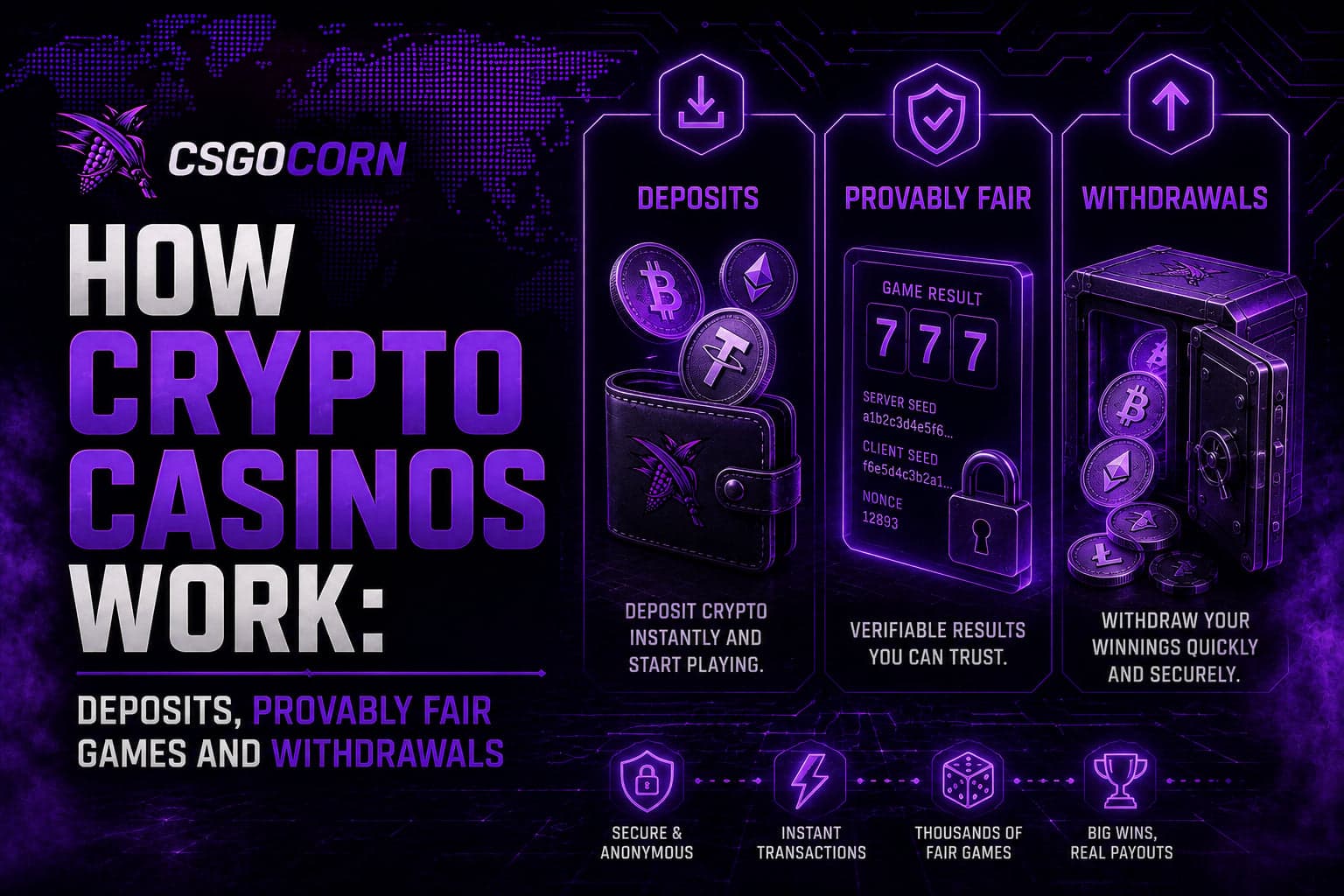
Crypto casinos have gone from a niche curiosity to one of the largest segments in online gambling, and the reasons are practical rather than ideological: deposits clear in minutes instead of days, withdrawals are not blocked by a card issuer, and the provably fair model lets you verify individual results in a way a traditional casino simply cannot offer.
That does not make them uniformly safe. The same properties that make crypto convenient — speed, finality, pseudonymity — also mean a bad platform can take your money with no chargeback to fall back on. This guide explains how crypto casinos actually work under the hood so you can judge one on the details rather than the marketing.
What is a crypto casino?
A crypto casino is an online gambling site that accepts cryptocurrency for deposits and withdrawals. Some are crypto-only. Many are hybrids that also take cards and bank transfers but settle most of their volume in Bitcoin, Ethereum, USDT and a handful of other coins.
Underneath, most run a familiar mix: slots and live dealer tables from third-party studios, alongside in-house "originals" like crash, dice, plinko, mines and limbo. The originals matter more than they look, because they are usually the games where provably fair verification is available — third-party slots almost never are.
How deposits work
When you deposit, the casino generates a receiving address tied to your account. You send coins to it, the network confirms the transaction, and your balance credits. Three things decide how that feels in practice:
- Required confirmations. Bitcoin deposits often need one to three blocks, so ten to thirty minutes. Faster chains credit in under a minute.
- Network fees. You pay these, not the casino. Sending $20 of Bitcoin during congestion can cost an embarrassing fraction of the deposit; the same $20 in USDT on Tron or Solana costs cents.
- Network selection. USDT exists on Ethereum, Tron, Solana, BSC and others. Sending on the wrong network is the single most common way people lose crypto to a casino, and it is usually unrecoverable.
Read the deposit page carefully, send a small test amount the first time on any new platform, and always match the network exactly.
Which coin should you actually use?
For most players, a stablecoin on a cheap network is the sensible default. USDT or USDC removes price volatility from the equation entirely — a $100 balance is still $100 tomorrow — and sending on Tron or Solana keeps fees negligible.
Bitcoin makes sense if it is what you already hold, but be aware you are taking a price position alongside your gambling position. Winning 20% while BTC drops 25% is a net loss, and that scenario is far more common than people expect. Litecoin and Dogecoin sit in between: cheap and fast to send, still volatile.
You can see which coins each platform actually supports on our crypto casino category page — support varies more than the marketing suggests.
Provably fair, RNG and licensing
These are three separate things and conflating them causes a lot of confusion.
Provably fair is a cryptographic commitment scheme. The casino publishes a hashed server seed before you play, your client seed is combined with it, and after the round both are revealed so you can recompute the outcome and confirm nothing was changed mid-round. It applies to in-house games and proves that specific results were not manipulated.
RNG certification is what third-party slot studios use instead — an independent lab tests the random number generator and audits the return-to-player figure. You cannot verify an individual spin, but the studio's output is audited in aggregate.
Licensing is a regulatory matter and largely separate from both. A licence tells you a body exists that will hear a complaint. Its usefulness depends enormously on which body it is.
The strongest combination is provably fair originals plus certified third-party games plus a licence you can actually verify on the regulator's own website. If you want to check a roll yourself, our guide on how provably fair works walks through the verification step by step, and RTP explained covers what those audited return figures actually mean.
Bonuses and the wagering requirement
Nearly every crypto casino leads with a deposit bonus, and the headline number is almost never the useful one. The number that matters is the wagering requirement: the total you must bet before bonus funds convert to a withdrawable balance.
A 100% bonus on a $100 deposit with 40x wagering means betting $4,000 before you can withdraw anything from it. Against a typical house edge, the expected cost of clearing that exceeds the bonus. A smaller bonus with 10x wagering is worth considerably more than a huge one with 50x.
Also check the game weighting — slots often count 100% toward wagering while live tables count 10% or nothing — and the maximum bet allowed while a bonus is active, since exceeding it commonly voids the whole thing.
Withdrawals and payout speed
This is where good and bad platforms separate most visibly. A well-run crypto casino processes withdrawals automatically, often within minutes, and publishes clear minimums. A poorly-run one introduces manual review, requests documents at the withdrawal stage rather than at signup, and lets requests sit for days.
Before depositing anywhere, check the minimum withdrawal amount, whether there is a daily or monthly cap, whether identity verification is required and at what point, and what independent reviews say specifically about payouts rather than about the games. Payout behaviour is the single most reliable quality signal in this industry, which is why it carries the heaviest weight in our own site reviews.
KYC and anonymity
The idea that crypto casinos are anonymous is increasingly outdated. Many now require identity verification above a withdrawal threshold, and regulated ones require it at signup. This is not necessarily a negative — a platform that verifies identity is generally one that intends to operate long-term.
What should concern you is a site that advertises no KYC and then demands documents only once you try to withdraw a large win. That pattern is a well-known stalling tactic. If verification is going to be required, you want to know before you deposit, not after you win.
Frequently asked questions
Are crypto casinos safe?
The well-established ones with verifiable licences, provably fair games and a consistent payout record are broadly as safe as any online casino. The category as a whole contains more bad actors than the regulated fiat market, so platform selection matters much more than it would elsewhere.
How long do crypto casino withdrawals take?
On a good platform, minutes — automated processing plus network confirmation time. Anything routinely taking over 24 hours without a stated reason is worth questioning.
Which cryptocurrency is best for a crypto casino?
A stablecoin such as USDT or USDC on a low-fee network, for most players. It removes price volatility and keeps transfer costs near zero.
What does provably fair actually guarantee?
That a specific round's outcome was committed to before you played and was not altered afterwards. It says nothing about the house edge, the platform's solvency, or whether it will pay you.
Do crypto casinos require KYC?
It varies. Licensed operators generally do, often triggered by a withdrawal threshold. Assume you may need to verify at some point and check the policy before depositing.
Can you win consistently at a crypto casino?
No. Every game carries a built-in house edge, and it applies over the long run regardless of strategy. Individual sessions can end well; the aggregate cannot.
Conclusion
Crypto casinos work well when the plumbing is right: correct network on deposit, a stablecoin to keep your balance predictable, provably fair games you can actually verify, honest wagering terms and automated withdrawals. Judge platforms on those specifics rather than on bonus size, test any new site with a small amount first, and treat every deposit as spent money. Gambling is entertainment for adults aged 18 and over — set a limit before you start, and if it stops being fun, stop.
Ready to pick one? We tested and ranked the crypto gambling sites — deposits, payouts, bonus terms and all.
See the tested crypto gambling sitesRelated posts
Best Crypto Plinko Sites in 2026
The best crypto plinko sites of 2026, hand-ranked on trust, provably fair verification, bonus value and payout speed — plus how plinko actually works before you play.
CryptoBest Crypto Mines Sites in 2026
The best crypto mines sites of 2026, hand-ranked on trust, provably fair verification, bonus value and payout speed — plus how mines actually works before you play.
CryptoBest Crypto Dice Sites in 2026
The best crypto dice sites of 2026, hand-ranked on trust, provably fair verification, bonus value and payout speed — plus how dice actually works before you play.