
Blackjack Basic Strategy: When to Hit, Stand, Double & Split (With Charts)
 CornieEditor & Lead ReviewerJuly 13, 2026 8 min read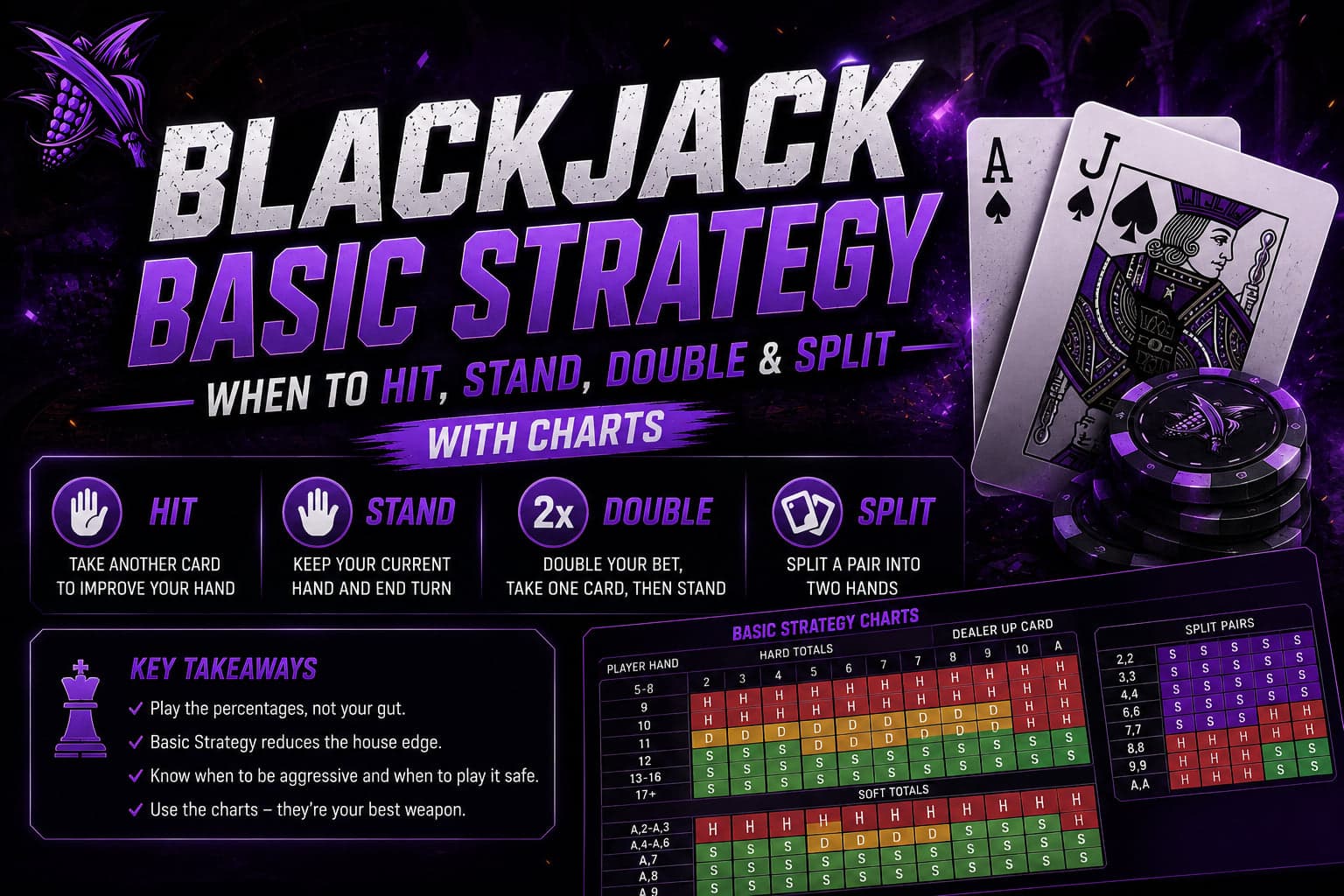
Blackjack is one of the very few casino games where your decisions genuinely matter. Play with correct basic strategy and you can push the house edge down to around 0.5% — one of the best returns you will find in any casino, online or crypto. Play on instinct and that edge can balloon to several percent. This guide gives you the complete basic strategy: colour-coded charts for every situation, plus clear explanations of exactly when to hit, stand, double and split, and why.
What is basic strategy?
Basic strategy is the mathematically optimal way to play every possible blackjack hand against every possible dealer up-card. It was worked out decades ago using probability and computer simulation, and it tells you the single best decision — the one that loses the least or wins the most over time — for any combination of your cards and the dealer’s visible card. It does not let you beat the house, but it squeezes the house edge to its absolute minimum.
The goal of blackjack (a quick recap)
Your aim is to beat the dealer’s hand without going over 21. Number cards are worth their face value, face cards (J, Q, K) are worth 10, and an Ace is worth 1 or 11 — whichever helps you more. You win if your hand is closer to 21 than the dealer’s, or if the dealer busts. A “blackjack” (an Ace plus a 10-value card) usually pays 3:2 and is the best possible hand.
Hard totals, soft totals and pairs
- Hard totals — hands with no Ace, or where the Ace must count as 1 (otherwise you would bust). Example: 10 + 6 = hard 16.
- Soft totals — hands with an Ace counting as 11. Example: A + 6 = soft 17. These are safer because you cannot bust with the next card.
- Pairs — two cards of the same rank, where you can choose to split them into two separate hands.
Your four possible actions
- Hit (H): take another card.
- Stand (S): keep your current hand and end your turn.
- Double (D): double your bet and take exactly one more card. If doubling is not allowed, hit instead.
- Split (P): separate a pair into two hands, each with its own bet.
The basic strategy charts
How to read the charts: the left column is your hand, the top row is the dealer’s face-up card. H = Hit, S = Stand, D = Double if allowed (otherwise Hit), P = Split. Colours match the action so you can read the chart at a glance.
The charts below assume the most common online rules: four to eight decks and the dealer standing on soft 17. Find your hand on the left and the dealer’s up-card along the top, then play the action in that cell.
Hard totals
| Your hand | 2 | 3 | 4 | 5 | 6 | 7 | 8 | 9 | 10 | A |
|---|---|---|---|---|---|---|---|---|---|---|
| 8 | H | H | H | H | H | H | H | H | H | H |
| 9 | H | D | D | D | D | H | H | H | H | H |
| 10 | D | D | D | D | D | D | D | D | H | H |
| 11 | D | D | D | D | D | D | D | D | D | H |
| 12 | H | H | S | S | S | H | H | H | H | H |
| 13 | S | S | S | S | S | H | H | H | H | H |
| 14 | S | S | S | S | S | H | H | H | H | H |
| 15 | S | S | S | S | S | H | H | H | H | H |
| 16 | S | S | S | S | S | H | H | H | H | H |
| 17+ | S | S | S | S | S | S | S | S | S | S |
Hands of hard 17 or higher always stand. Hands of hard 8 or lower always hit. The interesting decisions live in the 9–16 range, where the dealer’s up-card decides everything: when the dealer shows a weak card (2–6) they are more likely to bust, so you stand on stiff hands and let them take the risk; when the dealer shows a strong card (7–A) you need to improve your hand and hit.
Soft totals
| Your hand | 2 | 3 | 4 | 5 | 6 | 7 | 8 | 9 | 10 | A |
|---|---|---|---|---|---|---|---|---|---|---|
| A,2 | H | H | H | D | D | H | H | H | H | H |
| A,3 | H | H | H | D | D | H | H | H | H | H |
| A,4 | H | H | D | D | D | H | H | H | H | H |
| A,5 | H | H | D | D | D | H | H | H | H | H |
| A,6 | H | D | D | D | D | H | H | H | H | H |
| A,7 | S | D | D | D | D | S | S | H | H | H |
| A,8 | S | S | S | S | S | S | S | S | S | S |
| A,9 | S | S | S | S | S | S | S | S | S | S |
Soft hands are flexible because the Ace protects you from busting on the next card, which is why doubling is so common here against weak dealer cards. Note soft 18 (A,7): you stand against a dealer 2, 7 or 8, double against 3–6, and hit against 9, 10 or Ace — a hand beginners very often misplay by always standing.
Pairs (splitting)
| Your pair | 2 | 3 | 4 | 5 | 6 | 7 | 8 | 9 | 10 | A |
|---|---|---|---|---|---|---|---|---|---|---|
| 2,2 | P | P | P | P | P | P | H | H | H | H |
| 3,3 | P | P | P | P | P | P | H | H | H | H |
| 4,4 | H | H | H | P | P | H | H | H | H | H |
| 5,5 | D | D | D | D | D | D | D | D | H | H |
| 6,6 | P | P | P | P | P | H | H | H | H | H |
| 7,7 | P | P | P | P | P | P | H | H | H | H |
| 8,8 | P | P | P | P | P | P | P | P | P | P |
| 9,9 | P | P | P | P | P | S | P | P | S | S |
| 10,10 | S | S | S | S | S | S | S | S | S | S |
| A,A | P | P | P | P | P | P | P | P | P | P |
Two rules are worth memorising immediately: always split Aces and 8s, and never split 5s or 10s. Splitting Aces gives you two chances at a strong hand; splitting 8s turns a terrible 16 into two playable hands. A pair of 5s is a strong 10 — double or hit it instead — and a pair of 10s is a powerful 20 you should never break up.
Key rules of thumb
- Always stand on hard 17 or higher; always hit hard 8 or lower.
- Stand on hard 12–16 when the dealer shows 2–6; hit them when the dealer shows 7 or higher.
- Double hard 11 against almost anything, and double 10 against a dealer 2–9.
- Always split Aces and 8s; never split 5s or 10s.
- Treat soft hands aggressively — double soft 13–18 against weak dealer up-cards.
Common blackjack mistakes to avoid
- Standing on 16 vs a strong dealer card: painful, but hitting is mathematically correct against a 7 through Ace.
- Not doubling enough: skipping profitable doubles leaves money on the table over time.
- Taking insurance: insurance is a side bet with a poor house edge — basic strategy says decline it.
- Playing by feel: hunches cost you. The chart is right far more often than your gut.
- Copying the dealer’s rules: always hitting to 17 like the dealer ignores your biggest advantage — the freedom to stand.
A note on card counting
Basic strategy minimises the house edge but does not overcome it. Card counting attempts to gain a real edge by tracking the ratio of high to low cards, but it is difficult, requires specific conditions, and is largely ineffective online where the shoe is shuffled every hand (and impossible on RNG-based blackjack). For the vast majority of players, mastering basic strategy is the realistic goal.
Bankroll and responsible play
Even perfect basic strategy leaves a small house edge, so blackjack is still gambling. Set a budget before you sit down, decide on a unit bet that lets you absorb the natural swings, and never chase losses. Look for tables and games with player-friendly rules — 3:2 blackjack payouts and the dealer standing on soft 17 both improve your odds. And remember to check the best crypto casinos for blackjack variants and welcome bonuses before you play.
Frequently Asked Questions
Does basic strategy guarantee I will win?
No. Basic strategy minimises the house edge to around 0.5% under good rules, but it does not eliminate it. It ensures you make the best possible decision on every hand, which is the most you can control — the rest is variance.
When should I double down?
Most often on a hard 10 or 11 against a weaker dealer card, and on soft 13–18 against dealer up-cards of 4–6. The charts above show every doubling situation. If doubling is not allowed, hit instead.
Which pairs should I always split?
Always split Aces and 8s. Never split 5s (play them as a 10) or 10s (a strong 20). Other pairs depend on the dealer’s up-card — see the pairs chart.
Should I take insurance?
No. Insurance is a side bet that carries a high house edge, and basic strategy recommends declining it every time, even with a strong hand.
Does basic strategy work for online and crypto blackjack?
Yes. Basic strategy is based on the rules and odds of the game, so it applies to online, live-dealer and crypto blackjack alike. Just make sure the chart matches the specific rules in play, such as how many decks are used and whether the dealer hits or stands on soft 17.
Conclusion
Blackjack rewards discipline like almost no other casino game. Learn the three charts — hard totals, soft totals and pairs — internalise the rules of thumb, avoid the common mistakes, and you will be playing at close to the theoretical best, with a house edge as low as it gets. Print the charts, keep them beside you while you play, and let the maths make your decisions. Blackjack is strictly for players aged 18 and over — set a budget and always play responsibly.
Ready to pick one? We tested and ranked the crypto gambling sites — deposits, payouts, bonus terms and all.
See the tested crypto gambling sitesRelated posts
Best Crypto Plinko Sites in 2026
The best crypto plinko sites of 2026, hand-ranked on trust, provably fair verification, bonus value and payout speed — plus how plinko actually works before you play.
CryptoBest Crypto Mines Sites in 2026
The best crypto mines sites of 2026, hand-ranked on trust, provably fair verification, bonus value and payout speed — plus how mines actually works before you play.
CryptoBest Crypto Dice Sites in 2026
The best crypto dice sites of 2026, hand-ranked on trust, provably fair verification, bonus value and payout speed — plus how dice actually works before you play.